
Introduction
In the processing of bulk products—such as powders, granules, flakes, and slurries—contamination is a constant and costly threat. While traditional metal detectors are useful for catching ferrous and non-ferrous metals, they often miss dangerous non-metallic contaminants like glass shards, stones, bone fragments, or high-density plastics.
To achieve complete quality control, modern manufacturers are turning to X-ray foreign object detection for bulk materials. These advanced systems provide a non-destructive way to see inside the product stream, identifying a wide range of physical hazards without interrupting production.
In this article, we will explore the 7 critical uses of an X-ray foreign object detection machine for bulk products and how it transforms quality assurance on the production line.
What Is an X-Ray Machine for Bulk Products?
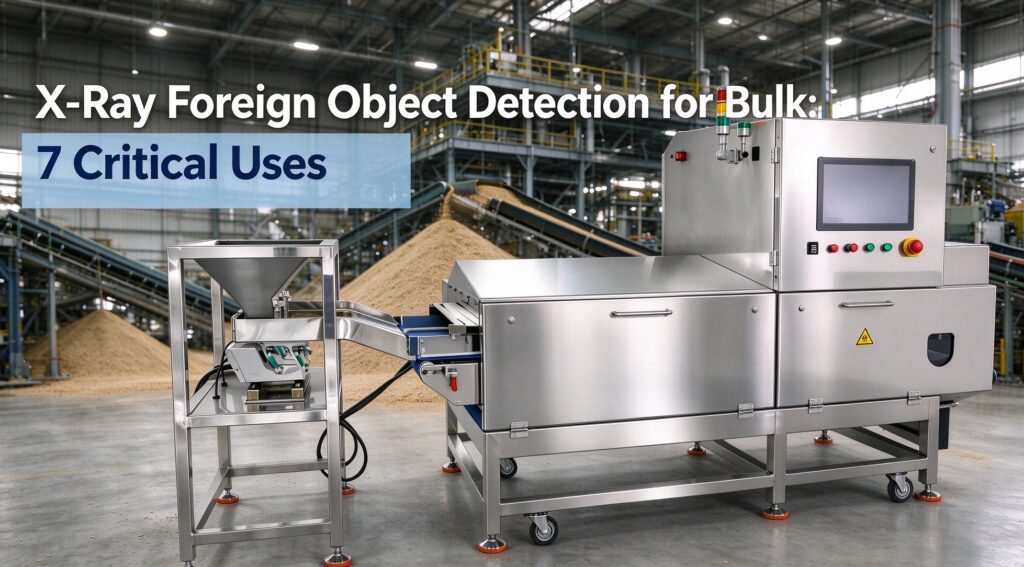
Unlike X-ray systems designed for packaged goods on a flat conveyor, an X-ray machine for bulk products is engineered to inspect loose, free-flowing materials.
The bulk material is typically fed through a vertical pipe (gravity free-fall) or a specialized narrow conveyor belt. As the material passes through the X-ray beam, the system measures the density of the product. Any object with a different density than the surrounding material—such as a metal screw, a piece of glass, or a stone—is instantly detected, and a pneumatic reject valve diverts the contaminated portion into a waste bin.
The 7 Critical Uses of Bulk X-Ray Inspection
1. Detecting Non-Metallic Contaminants
The most significant advantage of x-ray foreign object detection for bulk is its ability to find what metal detectors cannot. It effectively detects glass, ceramics, stones, bones, and high-density plastics. For food and pharmaceutical bulk materials, this comprehensive detection is vital for consumer safety.
2. Inspecting “Difficult” Products
Bulk materials often have challenging characteristics, such as high moisture, high salt content, or varying temperatures (e.g., frozen bulk vegetables). These factors can cause “product effects” that trigger false alarms in standard metal detectors. X-ray systems analyze actual density, making them highly accurate even for wet, conductive, or frozen bulk products.
3. Protecting Downstream Processing Equipment
A hidden stone or glass shard in a bulk powder can wreak havoc on extruders, mixers, pulverizers, and filling nozzles. By catching these contaminants early in the process, bulk x-ray inspection acts as a protective barrier, preventing severe equipment damage, reducing maintenance costs, and eliminating unexpected downtime.
4. Ensuring Regulatory Compliance
Food safety standards (such as HACCP, FDA, and BRC) are becoming increasingly stringent regarding physical hazards. An X-ray system provides a highly reliable Critical Control Point (CCP). With built-in data logging and image storage, you can easily prove compliance during audits, ensuring your facility meets global safety standards.
5. Minimizing Product Waste
Because the X-ray system operates in real-time and analyzes continuously, it rejects only the specific portion of bulk material containing the contaminant. This minimizes product giveaway and waste. Furthermore, the system’s high accuracy means fewer false rejections of perfectly good product, keeping your operational yield high.
6. Verifying Product Integrity
Beyond contamination, X-ray systems can also be used for basic quality checks. For example, they can detect missing components in mixed bulk products or identify clumps and agglomerations in powders that might affect downstream packaging or product consistency.
7. Improving Overall Line Efficiency
By automating the inspection process, X-ray systems eliminate the need for manual spot-checking. They operate at high speeds, handling high-volume throughput without slowing down the production line. The result is a smoother, more efficient operation with fewer interruptions.
X-Ray vs. Metal Detector for Bulk Materials
When upgrading your quality control, you might wonder: Do I need an X-ray machine or just a gravity metal detector?
| Feature | Gravity Metal Detector | X-Ray Foreign Object Detection |
|---|---|---|
| Detects Ferrous/Non-Ferrous Metals | ✅ Yes | ✅ Yes |
| Detects Stainless Steel | ✅ Yes | ✅ Yes |
| Detects Glass, Stones, Bones | ❌ No | ✅ Yes |
| Handles High Moisture/Salt Products | ❌ Struggles (False Alarms) | ✅ Excellent |
| Provides Visual Image | ❌ No | ✅ Yes (for verification) |
Note: If your facility strictly handles dry, metal-free raw materials, a metal detector may suffice. But for comprehensive physical hazard control, X-ray is the ultimate solution.
Typical Applications
X-ray foreign object detection for bulk is widely used across multiple industries:
Food & Beverage: Flour, sugar, coffee beans, tea, spices, frozen vegetables, and grains.
Plastics & Recycling: Plastic pellets, regrind, and shredded flakes.
Chemical & Pharmaceutical: Detergent powders, chemical granules, and raw pharmaceutical ingredients.
How to Choose the Right System
When selecting an X-ray foreign object detection machine for bulk products, consider these factors:
Material Handling: Will the product flow by gravity or on a conveyor? The aperture size must match your chute or belt width.
Throughput Rate: Ensure the system’s processing capacity matches your production speed (tons/hour).
Density Variation: If the bulk material has highly variable density, look for dual-energy X-ray systems for better accuracy.
Reject Mechanism: A fast pneumatic valve is crucial for free-fall bulk systems to minimize product waste.
Sanitation Standards: For food applications, choose models with stainless steel construction and IP65/IP66 washdown ratings.
JINDUN offers cutting-edge X-ray inspection systems tailored to bulk material handling. Our experts can help you integrate the right machine into your existing pipeline.
FAQ
Q: Can X-ray foreign object detection for bulk detect all types of metal?
A: Yes, X-ray systems can detect ferrous, non-ferrous, and stainless steel, just like a metal detector. However, X-ray also excels at detecting non-metallic contaminants like glass and stone.
Q: Is the X-ray machine safe for the bulk product?
A: Absolutely. The X-ray dose used for inspection is extremely low and does not alter the product, make it radioactive, or affect its taste or nutritional value.
Q: Will the X-ray machine handle high-speed bulk powder flow?
A: Yes. Modern systems use high-speed sensors and rapid pneumatic reject valves to inspect and divert contaminated material in milliseconds, without slowing down the production line.
Q: How do I test an X-ray machine for bulk products?
A: You test it by dropping certified test pieces (metal, glass, ceramic, or bone spheres) into the material flow and verifying that the system successfully detects and rejects them. This should be done regularly as part of your HACCP verification.
Conclusion
Choosing the right inspection technology is vital for your product’s safety and your brand’s reputation. While metal detectors have their place, x-ray foreign object detection for bulk offers a superior level of quality control by finding hazards that traditional systems miss.
With the 7 critical uses outlined above, it’s clear that upgrading to an X-ray machine for bulk products is a strategic investment in complete contamination control.
Key Takeaways:
X-ray detects glass, stones, and bones that metal detectors miss.
It is highly effective for difficult bulk materials with moisture or high salt content.
It protects downstream equipment from severe damage.
Regular testing and data logging ensure full HACCP compliance.
Ready to Upgrade Your Bulk Inspection?
Don’t let hidden contaminants put your production at risk. Contact JINDUN today to discuss your bulk X-ray inspection requirements. Our team of experts will help you select the ideal system, integrate it seamlessly, and provide ongoing support for your production line.
JINDUN – Precision Detection for Bulk Products.