
Introduction
In garment manufacturing, a single broken needle fragment can cause serious problems—injuries to consumers, costly recalls, and irreparable damage to your brand. That’s why needle detectors have become indispensable on modern garment production lines. These specialized machines detect and reject ferrous metal contaminants, including broken needles, pins, and staples, ensuring that no hazardous metal reaches the final product.
But a needle detector is more than just a safety device. It plays a vital role in quality control, operational efficiency, and compliance with international standards. In this article, we’ll explore the 5 ultimate uses of a needle detector in garment production and how JINDUN’s solutions can help you achieve flawless detection.
What Is a Needle Detector?
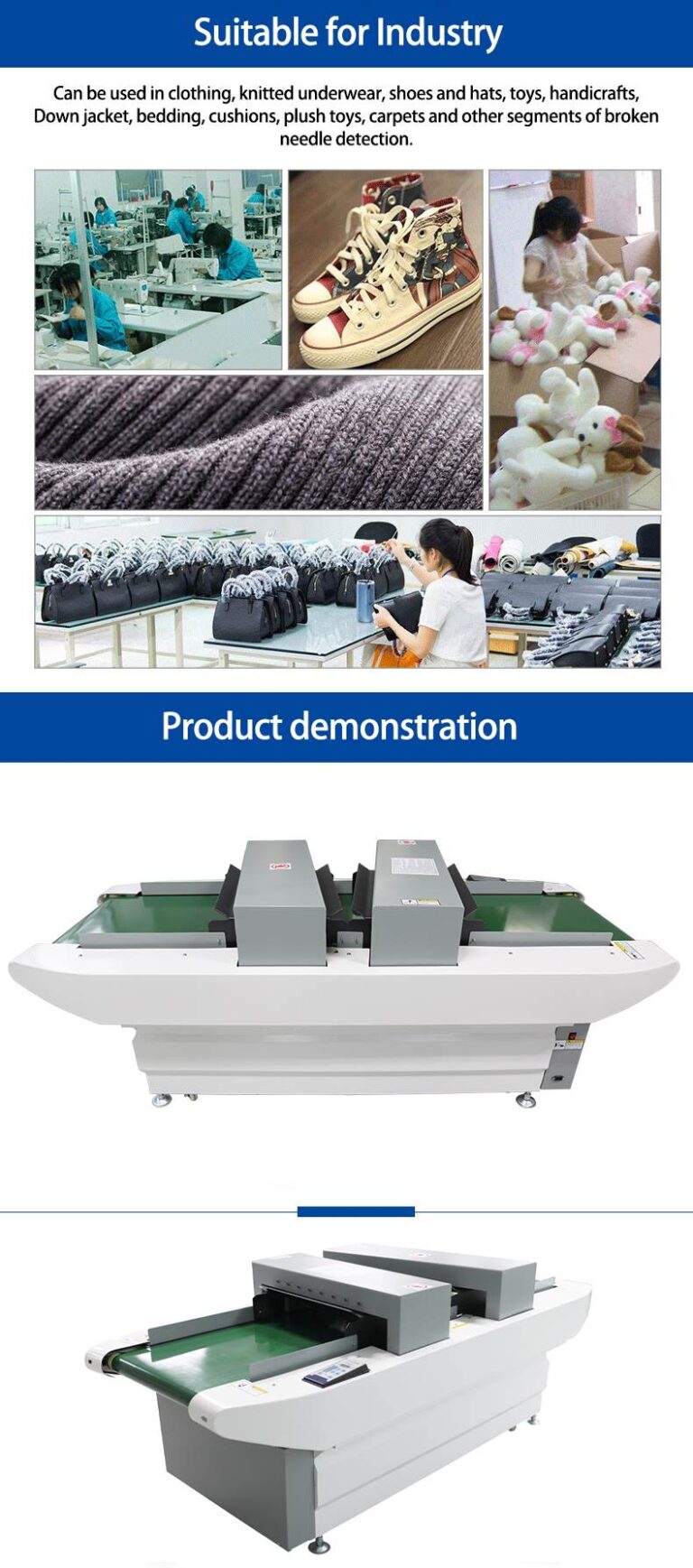
A needle detector is an industrial inspection machine designed to detect small ferrous metal particles in textile and garment products. It uses a strong magnetic field and high-sensitivity sensors to identify metal contaminants as products pass through the detection aperture. When metal is detected, the system alerts the operator or automatically rejects the item.
Unlike metal detectors used in food or packaging, needle detectors are optimized for the unique challenges of garments: thin fabrics, complex accessories (zippers, buttons), and high-speed production lines. They can detect broken needle tips as small as 0.8 mm, ensuring even the smallest fragments are caught.
The 5 Ultimate Uses of a Needle Detector in Garment Production
1. Ensuring Consumer Safety
The most critical use of a needle detector is protecting consumers from injury. Broken needles can remain embedded in fabric, and if they reach the end user, they can cause cuts, puncture wounds, or even choking hazards—especially in children’s clothing. A needle detector acts as a final safety barrier, scanning every garment before packaging.
For manufacturers exporting to markets like the EU, US, or Japan, needle detection is not optional—it’s a legal and moral requirement. JINDUN needle detectors deliver reliable detection with minimal false alarms, giving you confidence that no hazardous metal leaves your factory.
2. Meeting International Quality Standards
Many global retailers and brands mandate needle detection as part of their supplier requirements. Standards such as ISO 9001, BSCI, and customer-specific protocols often require documented needle control procedures. A needle detector provides verifiable evidence that you have taken all necessary steps to prevent metal contamination.
With JINDUN’s needle detectors, you can generate audit trails, calibration records, and reject reports, making compliance audits stress-free. This is especially important for garment factories supplying to major brands.
3. Reducing False Alarms and Improving Efficiency
False alarms are a common pain point in needle detection. They slow down production, increase waste, and frustrate operators. Modern needle detectors, like those from JINDUN, use advanced signal processing and auto-balance technology to distinguish between actual metal and product effects (such as zippers or metallic threads).
By minimizing false rejects, you keep your line running smoothly, reduce rework, and improve overall equipment effectiveness (OEE). This directly translates to cost savings and higher throughput.
4. Protecting Your Brand Reputation
A recall due to a needle fragment can destroy years of brand building. News travels fast, and consumers are quick to abandon brands they perceive as unsafe. A needle detector is your first line of defense against such disasters.
By integrating a needle detector into your production line, you demonstrate a commitment to quality and safety. This builds trust with your customers and partners, giving you a competitive edge in the global garment market.
5. Enhancing Operational Quality Control
Beyond safety, needle detectors contribute to overall quality control. They can detect not only broken needles but also other ferrous contaminants like staples, pins, and metal shavings from machinery. This helps you identify potential sources of contamination—such as worn cutting blades or poor maintenance—and address them proactively.
With data logging and connectivity features, JINDUN needle detectors allow you to track reject rates, analyze trends, and continuously improve your production processes. Quality control becomes data-driven and more effective.
Key Features to Look for in a Needle Detector
When selecting a needle detector for your garment factory, consider these features:
| Feature | Why It Matters |
|---|---|
| High sensitivity | Detects needle tips as small as 0.8 mm |
| Auto-balance | Maintains stable detection despite product variations |
| Multiple detection zones | Covers the entire width of the conveyor |
| Conveyor speed | Matches your production rate |
| Reject system | Automatic belt stop, alarm, or diverter |
| Data logging | Supports quality audits and traceability |
| Easy calibration | Reduces downtime and operator error |
| Durable construction | Withstands continuous industrial use |
JINDUN’s needle detectors are engineered with these features and more, ensuring reliable performance in the most demanding garment production environments.
How to Choose the Right Needle Detector
Selecting the right needle detector involves several factors:
Product type: Flat fabric, folded garments, or accessories?
Detection sensitivity: What is the smallest needle fragment you need to detect?
Line speed: How many pieces per minute do you need to inspect?
Conveyor width: Must accommodate your largest product.
Environment: Dust, humidity, or temperature extremes?
Compliance requirements: Do you need data logging, audit trails, or remote monitoring?
JINDUN offers a range of needle detectors to suit different applications and budgets. Our team can help you select the ideal model for your production line.
FAQ
Q: What is the difference between a needle detector and a metal detector?
A: Needle detectors are optimized for detecting small ferrous metal fragments (like broken needles) in textiles. Metal detectors are more general-purpose and can detect non-ferrous metals too, but they may not be as sensitive to tiny needle tips. Needle detectors are specifically designed for the garment industry.
Q: Can a needle detector detect stainless steel needles?
A: Most needle detectors are designed for ferrous metals. Stainless steel needles may be harder to detect, but some advanced models can detect them. Always check the specifications. JINDUN offers models with enhanced sensitivity for stainless steel.
Q: How often should I calibrate my needle detector?
A: Daily calibration checks are recommended for critical applications. Weekly checks are sufficient for less critical products. Always recalibrate after maintenance or product changeover.
Q: Will a needle detector work with garments that have zippers or metal buttons?
A: Yes, but these items can cause false alarms. Modern needle detectors with auto-balance and product learning can distinguish between accessories and actual contaminants. JINDUN’s detectors are designed to handle such challenges.
Q: Can a needle detector be integrated into an existing production line?
A: Absolutely. Needle detectors are typically installed as standalone units or integrated into conveyor systems. JINDUN provides custom integration support to ensure seamless operation.
Q: What happens when a needle is detected?
A: The system can automatically stop the conveyor, sound an alarm, and mark the contaminated item. The operator then removes the item for further inspection. Some models can also divert the product to a reject bin.
Conclusion
A needle detector is not just a piece of equipment—it’s a strategic investment in safety, quality, and brand reputation. With the 5 ultimate uses outlined above, it’s clear that every garment production line can benefit from reliable needle detection.
Whether you’re producing children’s wear, fashion apparel, or technical textiles, JINDUN has a needle detector to meet your needs. Our systems are designed for high sensitivity, durability, and ease of use, helping you achieve compliance and peace of mind.
Key takeaways:
Protects consumers from needle injuries
Ensures compliance with international standards
Reduces false alarms and improves efficiency
Protects your brand from recalls
Enhances overall quality control
Ready to Protect Your Garment Production?
Don’t leave safety to chance. Contact JINDUN today to discuss your needle detection requirements. Our experts will help you choose the right needle detector, integrate it seamlessly, and train your team for optimal performance.
JINDUN – Precision Detection for Safer Garments.
Can a standard metal detector replace a needle detector in apparel production?
No. Standard metal detectors are optimised for bulk or packaged products. Garment-grade needle detectors are designed for thin steel fragments in textiles and offer much higher sensitivity.
What detection sensitivity is required for export garment orders?
Most buyers expect detection of steel fragments as small as 0.8–1.2 mm, depending on product type and risk category.
How often should garment factories test needle detection performance?
Best practice is to test at every shift change and after any line adjustment, using certified test pieces.
Does fabric type affect needle detection accuracy?
Yes. Dense or layered materials influence signal behaviour. Professional systems compensate for this automatically.
How many needle detectors does a medium-sized factory usually need?
Typically, one per finishing line, but high-risk products or high-volume plants may require multiple checkpoints.