
A needle detector machine is the one piece of equipment almost every export-oriented garment factory owns, uses every shift, and can never remove from the line. Its job sounds simple — find broken sewing needle fragments inside finished clothing — yet it sits at the intersection of consumer safety, buyer audits and the commercial survival of a factory’s order book. When the machine alarms, it is usually saving a shipment, not slowing one down.
In this guide you will learn what it does, why the garment industry depends on it more than any other sector, where it belongs in the production flow, four real application scenarios from factories of different sizes, and how to choose the configuration that fits your own line.
What Is a Needle Detector in the Garment Industry?
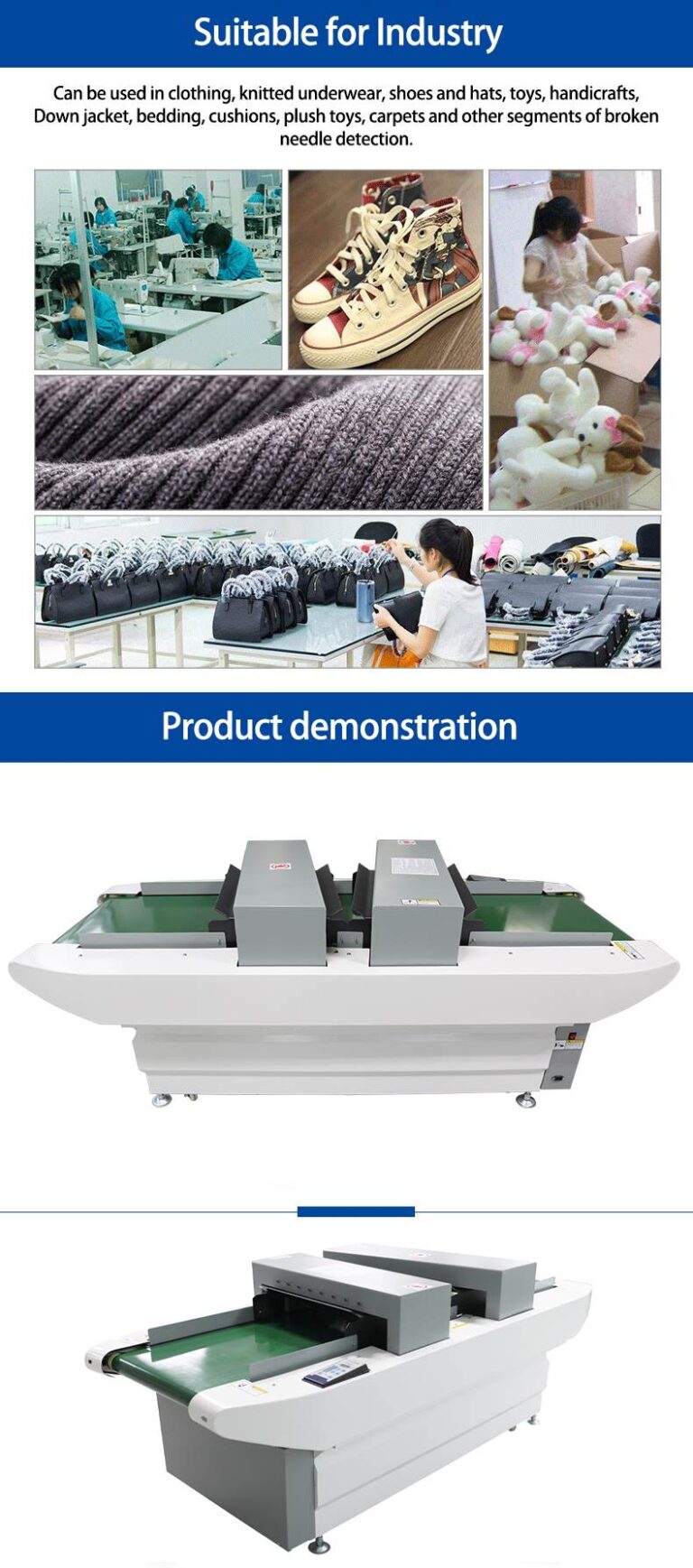
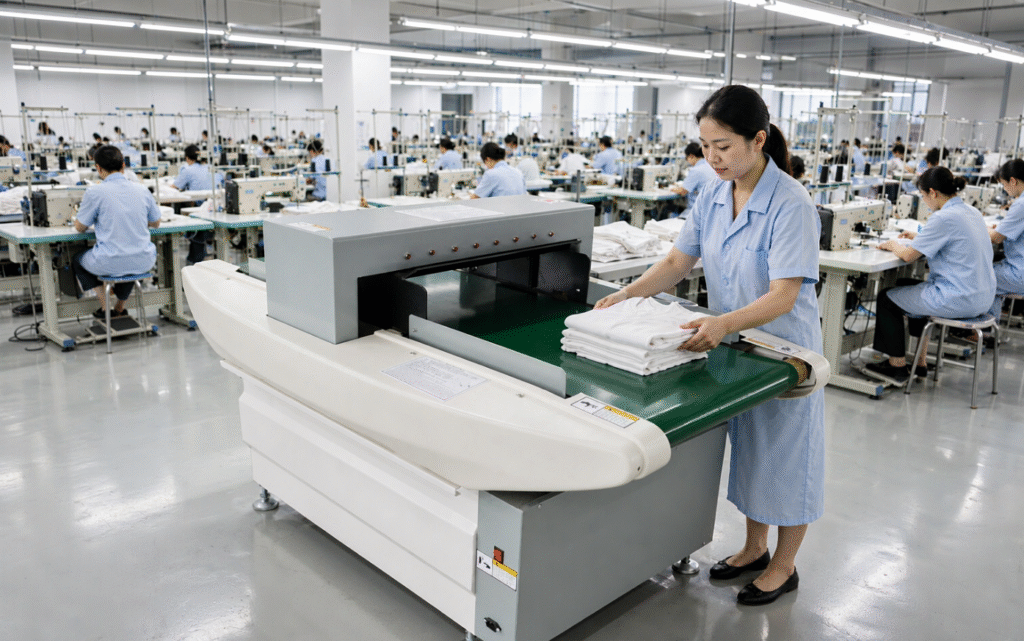
A needle detector (also called a broken needle detector or garment metal detector) is an inspection machine that identifies ferromagnetic metal fragments — most commonly broken sewing machine needle tips — inside finished garments, textiles, and soft goods. Garments pass on a conveyor through a magnetic detection tunnel; if metal is present, the machine alarms and stops, and the rejected piece is isolated for re-inspection.
Modern conveyor needle detectors combine high magnetic sensitivity with digital signal processing, allowing them to find a needle tip as small as a fraction of a millimeter even inside thick, multi-layer fabric such as denim, padding, or quilted jackets. Unlike a handheld detector wand, a conveyor system performs 100% whole-garment inspection at production speed — typically hundreds of pieces per hour — without relying on operator attention.
7 Reasons Why Needle Detectors Are Widely Used in Garment Production
1. Broken needles are the number-one metal hazard in garments
Garment manufacturing is one of the few industries where the contamination risk is built into the process itself. A typical sewing line uses thousands of needles, and needles do break — a bent needle can snap against a presser foot or a zipper, leaving the tip embedded in the seam. Unlike food processing, where metal contamination comes from many sources, in garments the hazard is predictable, recurring, and concentrated at the sewing stage. A needle detector is the only reliable way to verify that none of those broken tips left the factory inside the product.
2. Buyers and brands make needle detection mandatory
Most international retailers, brands, and buying offices — especially in Japan, Europe, and North America — require garment suppliers to implement a documented needle control policy. It is common for purchase contracts to state that every piece must pass metal detection before packing, and that each shipment must be accompanied by a needle detection report or certificate. Factories that cannot provide this documentation are routinely excluded from supplier lists or fail on-site buyer audits. In other words, for an export-oriented garment factory, a needle detector is not a quality upgrade — it is a ticket to the market.
3. Consumer safety and legal liability
A needle tip inside a baby onesie, a sock, or a T-shirt can cause serious injury — and the legal consequences follow the brand, the importer, and often the manufacturer. Children’s wear, infant clothing, and underwear are the most sensitive categories, and many national product-safety regulations treat sharp metal fragments in clothing as a critical defect. 100% needle inspection before shipment is the practical way a factory demonstrates due diligence and protects itself in the event of a claim.
4. Compliance with export-market requirements and audits
Needle detection is embedded in the audit frameworks that global buyers use to evaluate garment suppliers, alongside social compliance and quality systems. During a third-party inspection or a customer factory audit, inspectors will typically check not only that a needle detector exists, but also how it is calibrated, how rejected pieces are handled, and whether detection records are kept per shipment. A properly integrated needle detection process turns a potentially stressful audit item into a routine checkmark.
5. Brand reputation protection at low cost
Compare the cost of a conveyor needle detector with the cost of one recall or one viral customer complaint about a needle in a garment. For most factories, the machine pays for itself the first time it prevents a single rejected shipment. It also reduces the hidden costs of manual needle-checking: slower inspection, human error, and inconsistent results between shifts.
6. Higher production efficiency and traceability
Modern needle detectors are designed for production environments, not laboratories. Digital sensitivity settings, auto-conveyor stop or auto-reject modes, counter functions, and batch reporting let QC teams run continuous inspection with minimal training. Many models record pass/fail counts per shift, which gives managers real traceability data for every order — exactly the kind of documentation buyers increasingly ask for.
7. It supports a complete broken-needle control system
Best-practice factories treat the needle detector as the final gate in a full needle management system: controlled needle issue and return at the sewing floor, broken-needle assembly records (all fragments must be recovered and matched), and final 100% machine detection before packing. The detector is what makes the whole system verifiable — without it, “we control needles” is only a promise.
Where Needle Detectors Fit in the Garment Production Flow
In a typical garment factory, needle detection sits between finishing and packing:
- After final pressing and trimming — garments are completely assembled, so no later process can introduce metal;
- Before tagging and poly-bagging — detection happens on the open garment, where a rejected piece can still be opened and repaired;
- At the packing station — in high-volume lines, double-belt models allow one operator to feed garments while another removes and re-checks rejects, keeping the line moving.
Placement matters: the detector should be the last operation before cartons are sealed, because any handling after detection can theoretically introduce metal again. This is why many buyers specify “needle detection after packing preparation” in their QC manuals.
Real-World Application Cases
Case 1: Children’s wear exporter — passing a Japanese buyer audit
A children’s wear manufacturer exporting to Japan was asked by its buyer to implement a documented needle control policy after a near-miss: a broken needle tip was found during a random third-party inspection of an incoming container. The factory installed a conveyor needle detector at the finishing-packing boundary, introduced numbered needle issue/return records at every sewing machine, and began producing a per-shipment detection report. At the next buyer audit, the needle control section passed with zero findings — and the factory retained a program that accounts for a major share of its annual revenue.
Case 2: Denim factory — detecting fragments inside thick multi-layer fabric
Denim is one of the hardest products to inspect: heavy fabric, multiple seam layers, rivets and buttons everywhere. A denim manufacturer producing for a European brand was worried that metal trims would trigger constant false alarms. The solution was a high-sensitivity digital needle detector with adjustable sensitivity levels, calibrated so that ferrous fragments the size of a broken needle tip were detected reliably while non-ferrous trims did not saturate the signal. Combined with a simple rule — metal accessories are attached only after the detection point where technically possible — the factory achieved consistent detection results with a manageable reject rate.
Case 3: High-volume sportswear line — double-belt inspection before packing
A sportswear producer running several thousand pieces per day found that a single-belt detector was creating a bottleneck at the packing area. Switching to a double-belt needle detector allowed two operators to inspect in parallel — one feeding, one handling rejects and re-checks — without adding floor space. The result: inspection no longer delayed container loading, and the pass/fail counter data per shift became part of the shipment QC file that the brand’s field team reviews during audits.
Case 4: Small workshop — compact machine, same compliance
Needle detection is not only for large factories. A small knitwear workshop supplying a regional supermarket chain needed to meet the same buyer requirement as its larger competitors but had limited space and budget. A compact, mobile needle detector on casters — moved between the packing tables as needed — allowed the workshop to run 100% inspection and issue detection records, keeping the account without restructuring the whole workshop.
How to Choose a Needle Detector for Your Garment Line
When garment factories ask us which machine fits their line, the answer usually comes down to four questions:
| Selection factor | What to consider |
|---|---|
| Detection sensitivity | Must reliably detect the smallest ferrous fragment relevant to your buyer’s standard, through the thickest fabric you produce (denim and padding need more headroom than knits). |
| Detector tunnel size | The tunnel height and belt width must fit your largest folded garment or packed piece with margin — an undersized tunnel forces awkward passes and missed areas. |
| Throughput and belt layout | Single-belt models suit small and mid-size lines; double-belt models double parallel capacity at the packing station for high-volume factories. |
| Reject handling and records | Auto-stop, alarm-and-continue, or reject confirmation modes; counters and batch reports support buyer audit documentation. |
Frequently Asked Questions
What can a garment needle detector actually detect?
Can a needle detector be fooled by garment metal accessories like zippers or rivets?
Do we need to inspect every single piece, or just samples?
What documentation does a needle detector provide for buyer audits?
How often should a needle detector be calibrated or verified?
Conclusion: Needle Detection Is Now Part of the Cost of Selling Garments
Needle detectors are widely used in the garment industry for a simple reason: they solve a hazard that only this industry has, at the exact point where buyers, regulators, and consumers all demand proof. For an export factory, a conveyor needle detector is simultaneously a safety device, an audit tool, and a market-access requirement. Choosing the right configuration — tunnel size, belt layout, sensitivity, and records — turns it from a compliance expense into a genuine competitive advantage.
Need a Needle Detector That Fits Your Production Line?
JINDUN manufactures conveyor, double-belt, and compact needle detectors for garment factories — with customization for tunnel size, belt width, sensitivity, and reject handling. Send us your garment type and daily output, and our engineers will recommend the right configuration.