Metal Detector for Aluminum Foil VS Full Metal Detector
Table of Contents
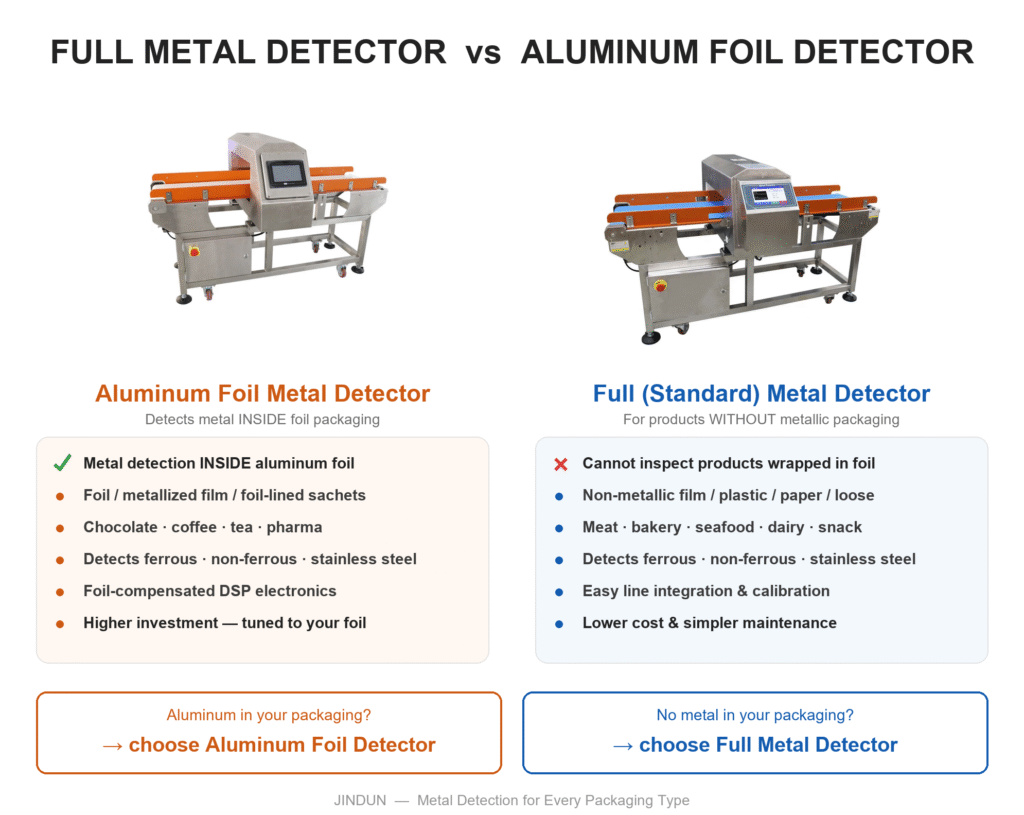
Full Metal Detector vs. Aluminum Foil Metal Detector: Which One Fits Your Packaging Line?
If your product is wrapped in aluminum foil, metallized film, or foil-lined sachets, a standard metal detector will flag every single package — a classic false-rejection problem. But a specialized aluminum foil metal detector can “see through” the foil and find real contamination inside.
So how do you know which machine your line actually needs? This guide breaks down the difference between a full metal detector and an aluminum foil metal detector, the strengths of each, and how to choose.
What Is a Full (Standard) Metal Detector?
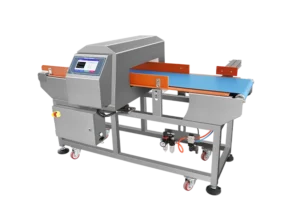
A full metal detector (also called a standard or general-purpose conveyor metal detector) uses a balanced-coil electromagnetic field to detect three groups of metals:
- Ferrous metals — iron and steel
- Non-ferrous metals — copper, brass, aluminum, lead
- Stainless steel
It is designed for products that are not wrapped in a metal barrier. Typical uses:
- Fresh / frozen meat, poultry and seafood
- Baked goods, bread and pastry
- Fruit, vegetables and nuts
- Snacks and confectionery in non-metallic film or plastic packaging
- Bulk and loose products on a conveyor
Key advantage: lower cost, high sensitivity to all three metal groups, easy to integrate, and ideal when the packaging itself contains no metal.
Key limitation: if the product is wrapped in aluminum foil, the foil’s own metal signal overwhelms the detector, causing almost continuous false rejects.
What Is an Aluminum Foil Metal Detector?
An aluminum foil metal detector is a specialized machine engineered specifically to inspect foil-wrapped or metallized products. It cancels out the constant signal coming from the aluminum foil itself, while still detecting foreign metal inside the product.
Typical applications:
- Chocolate bars, pralines and candy wrapped in foil
- Coffee, tea and beverage sachets / stick packs
- Pharmaceutical blister packs, strips and sachets (tablets, capsules, powder)
- Dehydrated soups, spices and seasonings in foil-lined bags
- Dairy and food powders in metallized film
Key advantage: the only realistic way to inspect products for metal contamination when the packaging itself contains aluminum.
Key limitation: it is a purpose-built machine — it costs more than a standard detector and is usually not needed if your packaging is non-metallic.
Key Differences at a Glance
Dimension | Full Metal Detector | Aluminum Foil Metal Detector |
Design purpose | General-purpose metal screening | Dedicated inspection of foil / metallized packaging |
Detects metal inside aluminum foil | No — foil triggers false reject | Yes — foil signal is cancelled out |
Detects ferrous / non-ferrous / stainless | All three | All three (foil is neutralised) |
Ideal packaging | Non-metallic film, plastic, paper, loose product | Aluminum foil, metallized film, foil-lined sachets |
Typical industries | Meat, bakery, seafood, dairy, snack | Confectionery, coffee/tea, pharma, powder food |
Cost | Lower | Higher (specialised electronics) |
Sensitivity | Excellent on non-foil products | Excellent within foil, tuned to foil type |
Best for | General food & production lines | Chocolate, sachets, blister packs, foil pouches |
Quick rule: No aluminum in the packaging → choose a full metal detector. Aluminum in the packaging → you need an aluminum foil metal detector.
How the Aluminum Foil Detector “Sees Through” Foil
A standard detector cannot work with foil because the aluminum reflects a strong, constant signal that drowns out any contamination signal.
The aluminum foil detector solves this with a foil-compensation / dynamic-balance approach:
- It continuously samples the foil’s signal as the package passes through.
- A digital signal processor (DSP) generates a matching “reference” signal for that specific foil.
- It subtracts the foil signal from the total signal.
- What remains is the contamination signal — which it then evaluates against the sensitivity threshold.
Because foil thickness, coating and format can vary between products, the machine is tuned to your specific foil and product, which is why it performs best when configured for the exact packaging you run.
When to Choose a Full Metal Detector
Choose a full metal detector when any one of these is true:
- Your product is loose or packaged in plastic / paper / non-metallic film.
- You want the lowest total cost and highest sensitivity across ferrous, non-ferrous and stainless.
- You need simple integration into an existing conveyor line.
- Your HACCP / Food Safety plan relies on standard metal detection with reject confirmation.
Advantages to highlight:
- Lower initial investment and simpler maintenance
- Detects all three metal types with high sensitivity
- Easy to calibrate and audit
- Widely familiar to food-safety auditors
When to Choose an Aluminum Foil Metal Detector
Choose an aluminum foil metal detector when any one of these is true:
- Your product is wrapped in aluminum foil, metallized film, or a foil-lined sachet / pouch.
- You are currently getting false rejects with a standard detector on foil products.
- You produce chocolate, coffee, tea, pharma blister packs or powder sachets.
- A food-safety audit requires real contaminant detection in the foil-wrapped product, not just rejection of the foil.
Advantages to highlight:
- Eliminates the false-rejection problem on foil — no more wasted product
- Finds real contamination the standard machine physically cannot
- Keeps your line running at speed while protecting brand reputation
- Supports HACCP compliance for foil-packaged food and pharma
How to Choose the Right Machine for Your Line
Follow these five steps to make the right call:
- Identify your packaging type. Is there aluminum / metal in the film or material touching the product? If yes → foil detector.
- Define the contamination risk. What metals are you worried about (ferrous, non-ferrous, stainless)? All three matter in most lines.
- Check operating speed and product size. Both machines are conveyor-based, but confirm belt width and throughput match your line.
- Review your food-safety standard. Your HACCP / BRC / IFS plan must state which machine supports detection.
- Confirm the reject system. Both need an automatic reject + lockable reject bin for audit proof.
JINDUN Solution: Metal Detection for Every Packaging Type
JINDUN designs and manufactures both standard full metal detectors and aluminum foil metal detectors, so you can match the machine to your actual packaging — rather than forcing one product to do everything.
- Conveyor metal detectors for general food, meat, bakery and loose products
- Aluminum foil metal detectors for confectionery, coffee, tea and pharmaceutical foil packaging
- Integrated reject systems, touchscreen HMI, HACCP-compliant data logging and audit-friendly reporting
Every system is factory-configured to your product and packaging, so the sensitivity defaults are correct for your line from day one.
FAQ
Q1. Can a standard metal detector detect metal inside aluminum foil?
No. Aluminum is itself a metal, so a standard detector sees the foil as continuous contamination and rejects nearly every package. Only a dedicated aluminum foil metal detector can inspect inside foil packaging.
Q2. Can an aluminum foil metal detector detect all types of metal?
Yes. After cancelling the foil signal, it still detects ferrous, non-ferrous and stainless steel contamination inside the product. Note that it is tuned to your specific foil, so it performs best when configured for your packaging.
Q3. Which detector is more sensitive — full or foil?
It depends on packaging. On non-foil products a standard detector is excellent. Inside foil packaging, only the foil detector can work at all, so it is the only sensitive option there.
Q4. Is an aluminum foil detector more expensive?
Generally yes, because it uses specialised signal-processing electronics. But it pays for itself by eliminating false rejects and the product waste they cause.
Q5. Can one machine do both foil and non-foil products?
Usually not with a single set-up. A foil detector is optimised for metallic packaging; a standard detector is optimised for non-metallic packaging. Choose based on your dominant packaging type, or discuss a dual-configuration option with JINDUN.
Contact US
Conclusion
Choosing between a full metal detector and an aluminum foil metal detector comes down to one question: does your packaging contain aluminum?
- No → a full metal detector gives you the best cost-to-performance for general food safety.
- Yes → you need a purpose-built aluminum foil metal detector to see past the foil and protect your product and brand.
Not sure which machine fits your line? Get a recommendation based on your real packaging material, product size and sensitivity requirements.
Contact JINDUN for Equipment Selection Support — tell us your packaging type and we’ll help you pick the right detector
Share With
Related Articles





Hot Products