Why Are X Ray Objection Machines So Widely Used in the Food Industry?
X ray objection machines have become one of the most widely adopted inspection technologies in the food industry — and for good reason. A single foreign object complaint can cost a food company far more than the product itself: retail delisting, a costly recall, and years of damage to a brand built over decades. Unlike traditional inspection methods, an X ray objection system can see inside the product and the packaging, detecting contaminants that no other inline technology can reliably find — which is exactly why more and more food manufacturers now install one on every production line.
In this guide, we explain what a food X ray objection machine is, the six main reasons food companies choose this technology, how it compares with a metal detector, and four real-world application cases from different food sectors. If you are evaluating inspection equipment for your production line, this article will help you understand why X ray objection has become the industry standard for food safety.
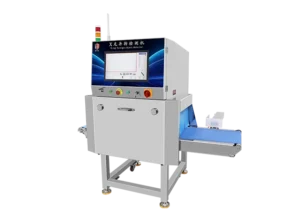
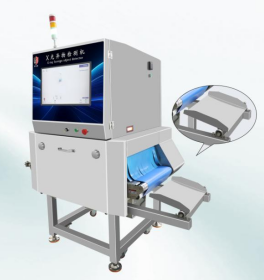
Food X ray objection machine with touchscreen control and reject-ready conveyor design.
What Is a Food X Ray Objection Machine?
A food X ray objection machine (also called an X ray foreign object detector or food X ray machine) uses a low-energy X ray generator and a detector array to scan products as they pass on a conveyor belt. Because different materials absorb X rays differently, the system builds a grayscale image of the product in real time. Dense contaminants — metal, glass, stone, bone, and some hard plastics — appear as dark spots against the lighter background of the food itself.
Powerful image-processing software analyzes every frame within milliseconds. When a contaminant is detected, the machine automatically activates a reject system — air blast, pusher, or drop flap — to remove the contaminated product from the line without stopping production.
Key point: X ray objection works through the packaging, including metallized film, foil, aluminum trays, and cartons. This is the single biggest technical advantage that drives food companies to adopt it.
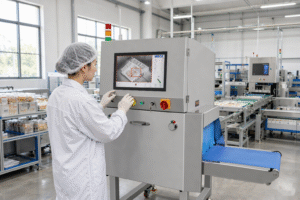
X ray objection machine on a packaged food line — inspection happens through the sealed packaging.
6 Reasons X Ray Objection Machines Are So Popular with Food Companies
1. One Machine Detects Many Types of Foreign Objects
A metal detector can only find metal. An X ray objection system detects a much wider range of physical hazards:
- Metal fragments (ferrous, non-ferrous, and stainless steel)
- Broken glass and glass shards — a major hazard in jarred and bottled products
- Stones and mineral clumps from raw materials
- Bone fragments in meat, poultry, and seafood products
- High-density plastics and rubber (e.g., machine seals, gaskets)
- Calcified and ceramic fragments
For a QA manager, this means one inspection point covers the full HACCP physical-hazard list instead of just one hazard type.
2. It Works with Foil and Metallized Packaging
More premium food products are packed in metallized film, aluminum foil lids, or foil trays — packaging that completely blinds a conventional metal detector. Because X ray imaging is density-based rather than electromagnetic, the machine still inspects the food inside foil packaging reliably. This is why snack producers, ready-meal manufacturers, and dairy companies increasingly specify X ray instead of, or in addition to, metal detection.
3. It Doubles as a Quality Check — Not Just Safety
Modern X ray systems do far more than find foreign objects. On the same pass through the machine, they can simultaneously perform:
- Missing item detection — is a sachet, spoon, or desiccant missing from the box?
- Mass estimation — flag underfilled packages before the checkweigher does
- Broken or deformed product detection — damaged biscuits, cracked products
- Fill-level control — for jars, bottles, and cans
- Count verification — pieces in a tray or box
One machine, multiple inspections — a strong return on investment that food companies appreciate when justifying capital expenditure.
4. Compliance with Retailer and Certification Requirements
Global food safety schemes — HACCP, BRCGS, IFS, FSSC 22000 — and the audit requirements of major retail chains and foodservice buyers all demand validated control of physical hazards. Many large buyers now explicitly require their suppliers to run X ray or metal detection as a critical control point (CCP). Installing an X ray objection machine makes third-party audits easier to pass and helps exporters meet the entry requirements of strict markets such as the EU, North America, Japan, and Australia.
5. Recall Prevention and Brand Protection
The cost of a food recall is enormous: product withdrawal, logistics, legal liability, regulatory penalties, and — hardest to recover — consumer trust. Industry studies consistently rank foreign object contamination among the top causes of food recalls. For food companies, an X ray machine is effectively an insurance policy: it catches the defective product before it catches the headlines.
6. High Speed, Full Inspection, Low False Rejection
Unlike manual sampling or end-of-line spot checks, X ray objection is a 100% inline inspection. Modern systems keep up with line speeds of well over 100 packs per minute while maintaining sensitive detection, and intelligent software keeps false rejection rates low — protecting both food safety and yield. With IP65-rated stainless steel washdown construction, today’s machines are also built to survive the reality of daily cleaning in a food plant.
Real-time detection: the software highlights a suspected contaminant inside the packaged product.
X Ray Objection vs Metal Detector: A Quick Comparison
Food companies often ask whether they need an X ray machine or a metal detector. The answer depends on the product, the packaging, and the hazards you must control:
|
Capability |
X Ray Objection Machine |
Metal Detector |
|
Metal detection |
Yes, including inside foil packaging |
Yes — highest sensitivity for metal-only hazards |
|
Glass, stone, bone, dense plastic |
Yes |
No |
|
Metallized film / foil packaging |
Fully compatible |
Severely limited or impossible |
|
Quality checks (missing items, mass, fill level) |
Yes, on the same pass |
No |
|
Typical investment |
Higher |
Lower |
|
Best for |
Complex hazards, foil packaging, premium & export products |
Metal-only risk, dry goods, budget-sensitive lines |
For many manufacturers the decision is simple: if the product is packed in foil, contains bone risk, or must satisfy strict retailer audits, X ray objection is the dependable choice. For dry goods in plain film packaging with metal-only hazards, a metal detector can still be the economical option.
4 Real Application Cases from Food Production Lines
The following cases are typical JINDUN application scenarios. They show why food companies in different sectors choose X ray objection — and what results they can expect. (Figures are representative of typical deployments; we are happy to share a reference case matched to your product during consultation.)
Case 1: Bone Fragment Control in Chicken Products (Poultry & Meat)
Problem: A poultry processor supplying frozen chicken portions to export markets faced repeated customer complaints about small bone fragments — a hazard its existing metal detectors could never address, because bone is not metal.
Solution: JINDUN X ray objection machines were installed after portioning and packing. The systems were calibrated specifically for low-density bone detection in poultry, with the reject system automatically removing any pack containing a bone fragment above the set size.
Result: Bone-related complaints dropped dramatically within the first months of operation, and the factory passed its next BRCGS audit with the X ray machine documented as the critical control point for physical hazards.
Case 2: Metallized Film Packaging That Blinded the Metal Detector (Bakery & Snacks)
Problem: A biscuit manufacturer upgraded to premium metallized film packaging for its export range — and its existing metal detectors immediately became unreliable due to the “product effect” of the foil.
Solution: X ray objection machines were placed at the end of each packaging line, inspecting every sealed pack through the metallized film. The same machines were also configured to detect broken biscuits and missing products in multipacks.
Result: Full foreign object detection was restored with no packaging change, and the bonus quality checks caught underweight and broken packs that previously reached customers.
Bakery line: X ray objection of packaged bread and biscuits before cartoning.
Case 3: Glass and Metal Detection in Frozen Fish Fillets (Seafood & Frozen)
Problem: A seafood processor producing frozen breaded fillets needed to control both metal fragments from processing equipment and occasional shell/glass fragments from raw material — two different hazards, one inspection point.
Solution: A JINDUN X ray machine rated for frozen product was installed directly after the freezing stage, with multi-frequency image algorithms tuned for the density profile of breaded frozen fillets.
Result: One machine now covers the plant’s entire physical hazard control plan for the line, with detection performance validated against certified test cards at every shift start.
Case 4: Missing Item and Fill-Level Checks on Ready Meal Trays (Ready Meals & Dairy)
Problem: A ready meal producer received complaints from a retail customer about trays missing a component — and occasionally about underfilled trays — issues invisible to its metal detectors.
Solution: X ray objection machines were installed after tray sealing. Beyond contaminant detection, the software was set up for missing-component identification and fill-level verification in one pass.
Result: Complaints from the retail customer fell to near zero, and the producer now uses the X ray records as audit-ready evidence of 100% inspection.
How Food Companies Choose the Right X Ray Objection Machine
Once a food company decides to invest in X ray objection, four factors determine the right configuration:
- Product and packaging: pack size, weight, shape, foil or film, and whether the product is fresh, frozen, hot, or dry all affect detector selection and calibration.
- Hazard profile: bone detection in meat needs different settings than glass-in-jars; choose a supplier who tests with your product, not just test blocks.
- Line speed and integration: the machine must match your peak throughput and fit physically into the line, including reject handling and upstream/downstream conveyors.
- Hygiene and environment: washdown-rated stainless steel construction (IP65 or better), tool-free belt removal, and easy calibration keep the machine audit-ready for years.
This is why we always recommend a product sample test before purchase: send JINDUN your real product samples — including any known contaminant samples — and we will provide actual X ray detection images and test reports, so you see the machine’s real performance on your product before you buy.
FAQ
Is X ray irradiation safe for food? Yes. The X ray energy used in inspection machines passes through the food in milliseconds and at power levels far below any effect on food quality, taste, or nutritional value. Food X ray objection equipment is designed and certified to meet international radiation safety standards, and the machine’s shielding ensures operator safety during normal production.
Can an X ray machine replace my metal detector? In most food applications, yes — an X ray machine detects the same metal hazards plus glass, stone, bone, and dense plastics, and works with foil packaging. If your hazard analysis is metal-only and your packaging is plain film, a metal detector remains a cost-effective option. Many food plants operate both, using each where it performs best.
What detection sensitivity can I expect? Sensitivity depends on the product, pack size, and contaminant type — there is no universal number. As a general guide, modern food X ray machines detect metal spheres in the sub-millimeter to low-millimeter range depending on where they sit in the pack, while glass, stone, and bone require larger sizes. The honest way to know: run a test on your actual product. JINDUN provides free sample testing with real X ray images.
Does X ray objection slow down my production line? No. X ray objection is inline and continuous, with standard models supporting typical packaging line speeds and higher on request. The machine inspects 100% of products at line speed and only diverts contaminated or defective packs through the reject system.
What maintenance does a food X ray machine need? Routine maintenance is light: regular belt cleaning, periodic sensitivity verification with certified test pieces, and an annual health check of the X ray tube and detector. Remote diagnostics support is available so most issues can be resolved without waiting for an on-site visit.
Conclusion
X ray objection machines have become the food industry’s preferred inspection technology for a simple reason: they solve problems that older technologies cannot. They see through foil packaging, detect the full range of physical hazards — not just metal — add automatic quality checks on every pack, and turn food safety compliance into documented, audit-ready evidence. For food companies competing in export markets and supplying major retailers, that combination is no longer a luxury; it is the baseline for staying on the shelf.
See X Ray Objection Performance on Your Own Product
Send us your product samples and JINDUN will provide a free detection test with real X ray images and a configuration recommendation for your line — meat, bakery, seafood, frozen, dairy, or ready meals.
💬 Chat with JINDUN on WhatsApp: https://api.whatsapp.com/send?phone=8613528535975
What metals can industrial detectors identify?
Industrial detectors detect ferrous, non-ferrous, and stainless steel metals depending on the technology used.
How sensitive are industrial metal detectors?
Typical sensitivity ranges from 0.5mm for ferrous metals up to 3mm for stainless steel.
Can detectors identify metals through packaging?
Yes. X-ray and electromagnetic technologies can detect metals even through dense or opaque packaging.
How often should detectors be calibrated?
Calibration is recommended monthly or as per the manufacturer’s guidelines to maintain accuracy.
Which industries benefit most from these detectors?
Food, beverage, pharmaceuticals, packaging, electronics, and chemical industries all benefit from reliable metal detection.
Share With
Related Articles




Hot Products