Aluminum Foil Metal Detector vs Standard: 5 Best Picks for Foil Packaging Lines
You just switched your potato chips from a paper bag to an aluminum foil pouch. The new packaging looks premium, the shelf life is longer, and then your standard metal detector starts rejecting 40% of the line. The shift supervisor says the machine is broken. It is not.
This is one of the most common — and most expensive — conversations in snack, confectionery and ready-meal production. A standard metal detector that worked perfectly on non-foil packaging becomes a false-reject machine the moment aluminum foil enters the line. Production managers then face a real question: do I need a standard metal detector or a dedicated aluminum foil metal detector?
This guide answers that question with the physics behind it, a step-by-step selection framework, real production cases, and a specification comparison you can take straight to your purchasing meeting. By the end, you will know exactly when an aluminum foil metal detector pays for itself — and when a standard conveyor metal detector is still the correct answer.
1. Why a Standard Metal Detector False-Alarms on Foil Packaging
Before choosing between the two machines, you need to understand why the problem exists at all. It is not a quality issue with your current detector. It is physics — and once you see it, the choice of an aluminum foil metal detector over a standard unit becomes obvious.
1.1 The Conductivity Problem
A standard metal detector works by generating a high-frequency electromagnetic field through a balanced coil system. When a conductive metal particle passes through, it disturbs that field, and the detector triggers. The key word here is conductive — and aluminum foil is extremely conductive.
Here is the issue: aluminum foil is a large, continuous sheet of conductive metal. To a standard detector’s coil, an empty foil pouch already looks like a very strong “metal signal” — often 5 to 20 times stronger than the signal of the small ferrous fragment you are actually trying to find. The standard metal detector cannot separate “the packaging is metal” from “there is metal inside the packaging.” That is exactly the gap an aluminum foil metal detector is engineered to close.
1.2 Product Effect and What It Costs You
This phenomenon has a name in the industry: product effect. Every product has a baseline electromagnetic signature. With foil packaging, that baseline is so strong that operators face an impossible trade-off:
|
What you try |
What happens |
|
Keep sensitivity high |
Constant false rejects — good product is pushed off the line, production stops for manual re-check |
|
Lower sensitivity to stop false alarms |
Real metal contaminants pass through undetected — a recall risk and a food-safety audit failure |
Neither option is acceptable. In a 2025 survey of food manufacturers, false rejects and re-inspection labor were cited among the top three hidden costs of inline inspection. Industry estimates put the total cost of a single product recall above $1 million when you include retrieval, disposal, brand damage and retailer penalties. A line that false-rejects continuously is quietly paying that price in slow motion — and that is why an aluminum foil metal detector earns its keep within months on a foil line.
1.3 What “Foil” Means in Practice
“Aluminum foil packaging” covers more than the shiny pouch on your shelf. In production reality it includes:
- Foil pouches and sachets — coffee, seasoning, dried meat, nuts, chocolate
- Aluminum trays and containers — ready meals, frozen foods, pet food
- Aluminum foil seals and lids — cups, jars, medicine bottles
- Blister packs and aluminum-plastic composite films — pharmaceuticals, health supplements
- Metallized film — snack bars, candy wrappers, cosmetic sachets
If any of these run through a standard metal detector, expect the false-reject problem. The more foil, the stronger the interference. This is exactly the environment an aluminum foil metal detector is designed for.
2. What Is an Aluminum Foil Metal Detector?
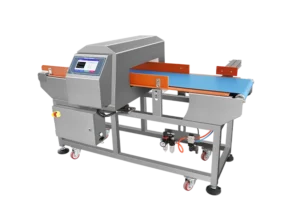
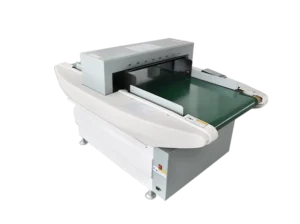
An aluminum foil metal detector (also called a foil packaging metal detector or foil-wrapped product metal detector) is a machine designed for exactly this scenario. Its job is to see past the foil and find the contaminant inside.
2.1 How It Works: Magnetic Induction Instead of Eddy-Current Balance
Instead of relying on the balanced-coil eddy-current method that struggles with large conductive surfaces, an aluminum foil metal detector uses magnetic field induction (also called low-cycle magnetization). It generates a magnetic field that magnetizes ferrous (iron-based) contaminants and detects the magnetic signature they create.
Here is the crucial point: aluminum is not magnetic. The foil does not respond to the magnetic field, so the aluminum foil metal detector ignores the packaging entirely and focuses on what is actually dangerous — iron, steel fragments, and other magnetic contaminants.
2.2 Phase Tracking and Anti-Interference
Modern aluminum foil metal detectors add a second layer: phase tracking. The signal from a contaminant and the signal from a product’s baseline arrive at slightly different angles (phases). The aluminum foil metal detector continuously tracks the product’s phase signature and suppresses it, while keeping full sensitivity to contaminant signals that arrive at a different phase. This is how the JINDUN JD-606 aluminum foil metal detector achieves a false-alarm rate below 0.1% on foil-packaged products that would cripple a standard unit.
2.3 What an Aluminum Foil Metal Detector Detects — and What It Does Not
Honest engineering starts with clear limitations. An aluminum foil metal detector detects:
- ✅ Ferrous metals — iron, low-alloy steel, broken tooling fragments, wire, rivets
- ✅ Magnetic stainless steel grades
- ✅ Steel contamination from equipment wear
It is not the right tool for:
- ⚠️ Non-ferrous metals (copper, brass, aluminum fragments) inside foil — aluminum is non-magnetic and blends into the foil background
- ⚠️ Non-magnetic stainless steel (e.g., 304/316) in foil packaging
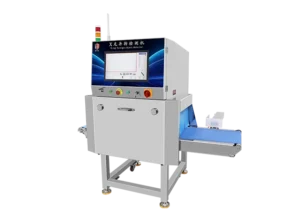
If your quality program requires detecting all metal types plus glass, stone and dense plastic in foil packaging, that is the scenario where X-ray inspection is the complementary technology — X-ray images the entire product, foil and all, and sees non-magnetic metals, stone and glass. The two technologies are not competitors; they are layered protection. An aluminum foil metal detector plus X-ray gives you full coverage. We cover this decision in Section 4 and Section 5.
3. Standard vs Aluminum Foil Detector: Full Comparison
Here is the side-by-side you need for your internal discussion. No marketing spin — just the engineering reality, comparing an aluminum foil metal detector against the standard unit on the same foil line.
|
Feature |
Standard Metal Detector |
Aluminum Foil Metal Detector |
|
Detection method |
Balanced coil, eddy current |
Magnetic field induction |
|
Works on non-foil packaging (plastic, paper, carton) |
✅ Yes |
✅ Yes |
|
Works on aluminum foil / metallized packaging |
❌ False rejects or missed contaminants |
✅ Designed for it |
|
Ferrous (iron/steel) detection on foil products |
❌ Unreliable |
✅ Fe Φ0.8–1.0 mm |
|
Non-ferrous (copper/aluminum) detection |
✅ Yes (non-foil) |
⚠️ Magnetic-only focus |
|
Stainless steel detection |
✅ Yes (non-foil) |
⚠️ Magnetic grades only |
|
Typical false-alarm rate on foil line |
High (often 30–50%+ rejections) |
<0.1% |
|
Typical price range (JINDUN) |
|
Within the same line range |
|
Best for |
General food/industrial lines, no foil |
Snacks, chocolate, coffee, ready meals, pharma, frozen food in foil |
The short version: a standard metal detector is the reliable workhorse for non-foil lines. An aluminum foil metal detector is the specialist for any line where foil touches your product. Choosing wrong costs more than the machine — it costs uptime, labor and audit standing.
4. How to Choose: A 5-Step Selection Framework
Use these five questions in order. They will take you to the right machine in under ten minutes — whether that ends with a standard unit, an aluminum foil metal detector, or a layered combination.
Step 1 — Does Your Packaging Contain Aluminum Foil or Metallized Film?
Start with the packaging, not the machine. Walk the line and list every SKU:
- Plain plastic pouches, cartons, glass jars → a standard food metal detector handles these well
- Any foil pouch, foil tray, foil seal, blister, metallized film → you need an aluminum foil metal detector
Rule of thumb: if even one of your major SKUs is foil-packaged, the line needs an aluminum foil metal detector. Running foil product through a standard unit means living with false rejects or blind spots — both unacceptable.
Step 2 — What Is Your Real Contaminant Risk?
Ask your quality team what foreign bodies actually appear in your process:
- Magnetic risk (broken blades, sieves, wire, machine wear) → an aluminum foil metal detector covers this on foil lines
- Mixed risk (magnetic + copper + stainless steel from upstream equipment) → on foil lines, plan a combination: aluminum foil metal detector as the first layer, X-ray inspection as the full-coverage layer
For a potato chip line, the dominant risk is ferrous fragments from cutting and frying equipment — exactly what an aluminum foil metal detector is built to catch. For a pharmaceutical blister line, regulators expect a documented inspection strategy; an aluminum foil metal detector for ferrous plus X-ray for full coverage is a defensible, audit-friendly setup. This layered approach also aligns with the HACCP plan most factories already maintain.
Step 3 — Calculate the Cost of False Rejects
False rejects are not free. Build this simple math for your finance team:
- Rejected product volume per shift (kg or units)
- Manual re-check labor hours
- Lost line time when the standard metal detector stops for verification
- Waste disposal if re-inspection is not economical
At typical line speeds of 22–28 m/min, a detector that stops every few minutes for manual checks can cost 2–4 hours of production per shift. Over a year, that is often more than the price difference between a standard metal detector and an aluminum foil metal detector.
Step 4 — Ask for a Product-Effect Test With Your Real Samples
Never buy on spec sheets alone. Every reputable manufacturer — including JINDUN — offers free sample testing: you send your actual foil-packaged products, the engineers run them through the aluminum foil metal detector, and you see the real sensitivity and rejection rate on your own product. This takes the guesswork out of the purchase and gives your quality team documented evidence for the HACCP plan.
Step 5 — Decide Whether You Need Full-Coverage Inspection
If your brand promises “zero foreign objects” — or your customers are retailers with strict audit requirements — consider the layered approach:
- Aluminum foil metal detector on the foil line → catches ferrous contamination reliably (Fe Φ0.8–1.0 mm, <0.1% false alarms)
- X-ray inspection at the end of the line → catches non-ferrous metal, stone, glass and dense plastic, foil or no foil
This is not an either/or. It is the same layered logic food-safety consultants recommend for critical control points. The aluminum foil metal detector gives you the cost-effective daily workhorse; X-ray adds the coverage layer where the risk profile demands it. Read more about this strategy in our packaging industry inspection guide.
5. Real Production Cases
Theory is useful; evidence is better. Here are three scenarios — all involving an aluminum foil metal detector on a real customer line — that mirror what we see every month in customer factories.
Case 1 — Potato Chip Line: From 40% Rejects to Stable Running
A snack producer ran foil pouches through a standard conveyor metal detector. The line rejected roughly 40% of finished bags — not because of contamination, but because the foil triggered the coil. Operators bypassed the detector during peak shifts, which created an obvious food-safety hole. The factory switched to an aluminum foil metal detector (JD-606B). False rejects dropped to near zero, the aluminum foil metal detector stayed inline at full sensitivity, and the bypass practice ended. Result: the line runs 22 m/min continuously, and sensitivity holds at Fe Φ0.8–1.0 mm on a 400 × 100 mm aperture.
Case 2 — Chocolate With Aluminum-Plastic Composite Wrapping
A confectionery manufacturer used aluminum-plastic composite film for premium chocolate bars. The composite’s conductive layer produced an unstable signal on their standard unit — sometimes rejecting clean bars, sometimes passing contaminated ones. The unstable behavior made calibration a daily ritual. After installing an aluminum foil metal detector with phase tracking, the machine’s auto-learn function stored the product signature and held a stable baseline shift after shift. Result: calibration frequency dropped from daily to per-SKU-change, and the false-alarm rate fell below 0.1%.
Case 3 — Frozen Ready Meals in Aluminum Trays
Ready-meal producers face a double challenge: aluminum trays plus cold-room operation. Standard metal detectors cannot cope with the tray; some “foil-capable” machines also struggle in low temperatures. The JD-606 aluminum foil metal detector line uses an imported food-grade Dutch conveyor belt rated for -20 °C to +65 °C, so the machine keeps working in cold storage conditions where rubber belts stiffen and slip. Result: the aluminum foil metal detector runs inside the cold chain at 28 m/min, and the alarm system records accepted/rejected counts for traceability.
Case 4 — When the Customer Upgrades to Full Coverage
A coffee packer started with an aluminum foil metal detector for their aluminum coffee bags — ferrous risk covered, false rejects gone. Later, their private-label customer requested full foreign-body inspection including non-ferrous metal. They added an X-ray inspection system at the end of the line. The aluminum foil metal detector still runs first as the workhorse; the X-ray unit now covers the full contaminant range with image data for every rejected pack. This layered setup is now the customer’s selling point in retailer audits.
6. When the Standard Metal Detector Is Still the Right Choice
Let’s be clear: the standard metal detector is not obsolete. It remains the right, cost-effective choice for the majority of lines:
- Non-foil packaging — plastic bags, flow wrap, cartons, glass jars
- Raw ingredients and bulk product — flour, grains, pellets, powders before packaging
- General industrial lines — plastics, textiles, electronics, hardware
- Budget-conscious first installations where packaging contains no conductive layer
A standard unit detects ferrous, non-ferrous and stainless steel contaminants (for example Fe Φ0.8 mm / Cu Φ1.0 mm / SUS Φ1.5 mm in a 400 × 100 mm aperture), runs at 120 pieces/min in typical configurations, and costs less than an X-ray system. The smart product portfolio uses the standard metal detector as the reliable first line of defense, adds an aluminum foil metal detector where foil appears, and layers X-ray where full coverage is required. The technology you choose should match the packaging you run — not the other way around.
7. JD-606 Aluminum Foil Metal Detector at a Glance
If your decision lands on an aluminum foil metal detector, here is the reference specification (JD-606 series, used across the cases above):
|
Parameter |
JD-606 Aluminum Foil Metal Detector |
|
Detection principle |
Magnetic induction — ferrous / magnetic metals only |
|
Detection aperture |
400 mm (W) × 100 mm (H), customizable |
|
Sensitivity |
Fe Φ0.8 – 1.0 mm |
|
Conveyor speed |
22 – 28 m/min, adjustable |
|
Conveyor belt |
Imported Dutch food-grade belt, -20 °C to +65 °C, cold-room rated |
|
Display |
9-inch touchscreen |
|
Product memory |
100 product parameter sets |
|
Sensitivity levels / anti-interference |
Adjustable 1–10 / 1–10 |
|
Alarm & reject |
Sound + light alarm, belt stop & reverse; optional auto-reject |
|
Counters |
Accepted / rejected count statistics |
|
Frame |
304 stainless steel, food-grade construction |
|
Power |
220V 50Hz, 200W |
|
Weight / dimensions |
180 kg / 1700 × 1100 × 900 mm |
|
Protection |
Leakage protection, self-check function |
|
Typical applications |
Foil-wrapped snacks, chocolate, coffee, dairy, ready meals, frozen foods, pharmaceuticals, candy |
Key selling points: designed for foil/aluminum-plastic packaging (where standard units false-alarm), cold-room-capable conveyor belt, leakage protection and self-check — features that matter when an aluminum foil metal detector runs 24/7 on a foil line.
FAQs
What is the average service life of a needle detector?
In industrial garment environments, a properly designed system typically operates reliably for 7–10 years with routine maintenance.
How do false rejects affect real production cost?
They increase labour, slow throughput, and create hidden delays that accumulate across thousands of garments.
Is a cheaper needle detector always more economical? No. Lower purchase price often leads to higher operational costs due to
No. Lower purchase price often leads to higher operational costs due to instability, downtime, and manual adjustment.
How often should a needle detector be calibrated?
Calibration frequency depends on material variation and environment. Well-designed systems reduce the need for frequent adjustment.
What do major apparel brands expect in audits?
Brands expect documented testing procedures, stable detection performance, and traceable inspection records throughout production.
Share With
Related Articles






Hot Products