
Table of Contents
Liquid Pipeline Metal Detector: 7 Critical Benefits
Introduction
In liquid food processing—whether you’re producing sauces, soups, dairy, beverages, or pharmaceuticals—metal contamination is a constant risk. Fragments from pumps, valves, pipes, or mixing equipment can enter the product stream undetected, leading to consumer injury, costly recalls, and severe brand damage.
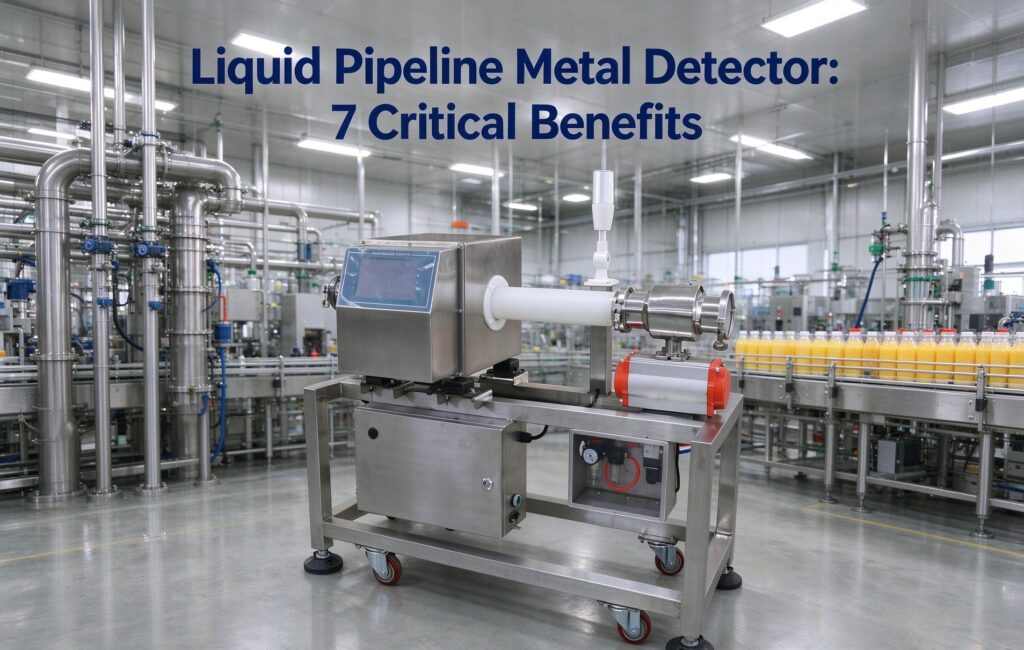
A liquid pipeline metal detector is the solution. Unlike traditional conveyor-based metal detectors, this system is installed directly inline on your pipeline, inspecting liquids, slurries, and pastes as they flow. It detects ferrous, non-ferrous, and stainless steel contaminants without interrupting production.
In this article, we’ll explore the 7 critical benefits of a liquid pipeline metal detector and why it has become an essential component of modern liquid processing lines.
What Is a Liquid Pipeline Metal Detector?
A liquid pipeline metal detector is a specialized inspection system designed to fit into existing pipework. The product flows through a detection coil, which generates an electromagnetic field. Any metal particle passing through disturbs the field, triggering a signal. A reject valve then diverts the contaminated batch or activates an alarm, ensuring no metal reaches downstream processes or final packaging.
Key features of pipeline metal detectors:
-
Sanitary design (often 3-A, EHEDG compliant)
-
Full stainless steel construction
-
CIP (Clean-in-Place) compatibility
-
No product waste during normal operation
-
High sensitivity even for viscous or high-temperature liquids
These systems are widely used in food, pharmaceutical, and chemical industries where product integrity is paramount.
7 Critical Benefits of a Liquid Pipeline Metal Detector
1. Uninterrupted Production Flow
Unlike conveyor-based metal detectors that require product to be placed on a belt, a pipeline metal detector inspects the product as it flows. There is no need to stop the line or manually transfer samples. This means 100% inspection without slowing down production. For high-volume liquid processing, this is a game-changer.
2. Superior Detection Sensitivity for Liquids
Liquids and slurries present unique challenges for metal detection. Product effect—caused by moisture, salt, or temperature—can mask signals. Modern pipeline metal detectors use advanced multi-frequency technology and phase discrimination to overcome these issues, achieving high sensitivity even in difficult products. You can detect particles as small as 0.5 mm Fe, 0.7 mm non-Fe, and 1.0 mm stainless steel, depending on the application.
3. Full Compliance with HACCP and FDA
Food safety standards such as HACCP, FDA, EU 1935/2004, and BRC require documented control of physical hazards. A liquid pipeline metal detector serves as a critical control point (CCP). With data logging, automatic calibration checks, and audit trails, it provides the evidence you need for inspections and customer audits. Peace of mind comes standard.
4. Prevention of Costly Recalls
One metal fragment in a single bottle of sauce can trigger a nationwide recall. The financial impact—logistics, refunds, legal fees—can reach millions. Perhaps even worse is the loss of consumer trust. By catching metal early in the process, a pipeline metal detector helps you avoid recalls entirely. It protects your brand and your bottom line.
5. Reduced Product Waste and Giveaway
Traditional inspection methods often require discarding entire batches if metal is found. Pipeline systems can be configured to reject only the contaminated portion—often just a few liters—minimizing waste. Additionally, because the system detects metal before filling, you avoid packaging contaminated product, saving both product and packaging materials.
6. Easy Integration and Minimal Maintenance
A liquid pipeline metal detector is designed to fit seamlessly into your existing pipework. Installation typically involves cutting a section of pipe and inserting the detector, with no major reconfiguration. Maintenance is straightforward: daily checks, periodic calibration, and cleaning as part of your CIP routine. There are no belts to track, no complex mechanics—just reliable, solid-state electronics.
7. Protection of Downstream Equipment
Metal contaminants don’t just threaten consumers—they also damage expensive equipment like homogenizers, filling nozzles, and pumps. A pipeline metal detector acts as a protective barrier, stopping metal before it reaches these critical components. This reduces downtime, extends equipment life, and lowers maintenance costs.
How a Liquid Pipeline Metal Detector Works
The system consists of three main components:
-
Detection coil: A ring-shaped coil surrounds the pipe. It generates a high-frequency electromagnetic field.
-
Control unit: Processes signals and distinguishes between product effect and actual metal.
-
Reject mechanism: Typically a valve that diverts contaminated product to a waste container or activates an alarm.
When metal passes through the coil, it creates a disturbance. The control unit analyzes the signal and, if it exceeds the threshold, triggers the reject. The entire process takes milliseconds, so production speed is unaffected.
Key Applications
Liquid pipeline metal detectors are used across many industries:
| Industry | Typical Products |
|---|---|
| Food & Beverage | Sauces, soups, juices, dairy, syrups, purees |
| Pharmaceutical | Liquid medicines, syrups, suspensions |
| Chemical | Slurries, pastes, detergents |
| Cosmetics | Lotions, creams, gels |
They are especially valuable for viscous products that cannot be easily inspected on a conveyor.
How to Choose the Right System
When selecting a liquid pipeline metal detector, consider:
-
Pipe diameter: Must match your existing pipeline.
-
Product characteristics: Viscosity, temperature, conductivity, and flow rate.
-
Sensitivity requirements: Smallest detectable metal particle.
-
Sanitary standards: 3-A, EHEDG, FDA-compliant materials.
-
Cleanability: CIP compatibility, smooth internal surfaces.
-
Connectivity: Data logging, Ethernet, OPC UA for Industry 4.0.
-
Reject options: Valve type, alarm, or diverter.
JINDUN offers a range of liquid pipeline metal detectors tailored to different applications. Our engineers can help you specify the ideal model for your line.
FAQ
Q: Can a liquid pipeline metal detector detect stainless steel?
A: Yes. Modern systems can detect stainless steel, including 316 grade, though sensitivity may be slightly lower than for ferrous metals.
Q: Will it work with high-viscosity products like tomato paste?
A: Yes. Pipeline detectors are designed for viscous products. However, the pipe diameter and flow rate must be suitable. Consult JINDUN for a tailored solution.
Q: Does the detector require regular calibration?
A: Yes. Daily calibration checks are recommended for critical applications. Weekly checks are sufficient for less critical products. The system can be calibrated automatically or manually.
Q: Can it be cleaned with CIP?
A: Most JINDUN pipeline metal detectors are CIP-compatible. They feature smooth, hygienic surfaces and are constructed from stainless steel.
Q: What happens when metal is detected?
A: The system activates a reject valve that diverts the contaminated product to a waste container. An alarm may also sound to alert operators. The contaminated portion is isolated, and production continues.
Q: Is a pipeline metal detector suitable for pharmaceutical liquids?
A: Absolutely. We offer models that meet pharmaceutical cleanliness standards, with FDA-compliant materials and validation support.
Conclusion
A liquid pipeline metal detector is not just a piece of equipment—it’s a strategic investment in product safety, regulatory compliance, and operational efficiency. With the 7 critical benefits outlined above, it’s clear that any liquid processing line can benefit from inline metal detection.
From preventing recalls to protecting downstream equipment, the advantages are compelling. And with JINDUN’s expertise, integration is seamless.
Key takeaways:
-
Inspects 100% of liquid product without slowing production
-
Achieves high sensitivity even in difficult products
-
Ensures HACCP and FDA compliance
-
Prevents costly recalls and protects your brand
-
Reduces waste and protects equipment
Ready to Protect Your Liquid Products?
Don’t let metal contamination put your business at risk. Contact JINDUN today to discuss your liquid pipeline metal detection needs. Our team will help you select the right system, integrate it into your line, and provide ongoing support.
JINDUN – Precision Detection for Liquid Processing.
Share With
Related Articles



Hot Products