Metal Detector and Checkweigher: Why Production Lines May Need Both
Metal Detector and Checkweigher: Why Production Lines May Need Both
Introduction
In food manufacturing, two quality control challenges demand constant attention: metal contamination and weight accuracy. A single metal fragment can trigger a product recall, while an underfilled or overfilled package can lead to regulatory fines and lost customer trust.
Many production managers assume that installing either a metal detector or a checkweigher is enough. But the truth is, these two systems solve completely different problems—and for many production lines, you need both.
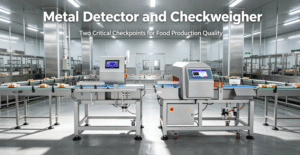
This article explains what each machine does, why they are not interchangeable, and how combining a metal detector and checkweigher can maximize safety, efficiency, and compliance on your production line.
What Is a Metal Detector?
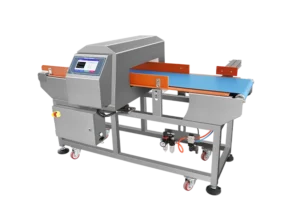
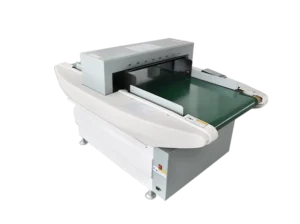
A metal detector is a system that identifies and rejects products containing unwanted metal contaminants—ferrous, non-ferrous, and stainless steel. It is typically installed at a critical control point (CCP) in the production line, such as after packaging or before final shipment.
How it works: The product passes through a detection coil that generates an electromagnetic field. Any metal inside the product disturbs this field, triggering a signal. The system then activates a reject mechanism (air blast, pusher, or flap) to remove the contaminated product from the line.
What it detects:
-
Ferrous metals (iron, steel)
-
Non-ferrous metals (aluminum, copper, brass)
-
Stainless steel (including difficult-to-detect 316 grade)
Primary purpose: Protect consumers from metal hazards and ensure food safety compliance (HACCP, FDA, EU regulations).
What Is a Checkweigher?
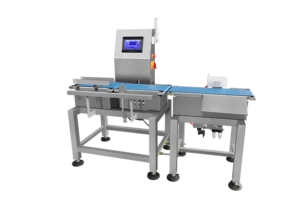
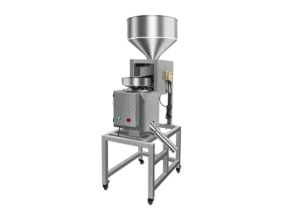
A checkweigher (also called a weight sorter or dynamic checkweigher) automatically weighs each product as it moves along the conveyor. It compares the actual weight against preset target and tolerance limits, then rejects any product that is under or over the acceptable range.
How it works: Products pass over a weigh platform equipped with load cells. The system captures the weight in motion, processes the signal, and makes a pass/fail decision in milliseconds. Rejected products are diverted to a separate lane.
What it measures:
-
Product weight accuracy
-
Fill quantity consistency
-
Package completeness (e.g., missing items)
Primary purpose: Ensure weight compliance, reduce product giveaway, and maintain packaging quality.
Why Production Lines Need Both
The confusion often arises because both machines are installed on the production line and both have a “reject” function. But they inspect completely different attributes.
| Inspection Task | Metal Detector | Checkweigher |
|---|---|---|
| Detect metal contamination | ✅ Yes | ❌ No |
| Verify product weight | ❌ No | ✅ Yes |
| Detect missing components | ❌ Limited | ✅ Yes (if weight differs) |
| Ensure HACCP compliance | ✅ Critical | ✅ Supports |
| Reduce product giveaway | ❌ No | ✅ Yes |
Metal detectors cannot weigh products, and checkweighers cannot detect metal. They are complementary, not competitive.
The Risk of Choosing Only One
-
Only a metal detector: You catch metal, but you may still ship underfilled or overfilled packages. This leads to customer complaints, regulatory penalties, and unnecessary product giveaway.
-
Only a checkweigher: You control weight, but metal contaminants pass through undetected. A single recall can cost millions and destroy brand reputation.
For many food and pharmaceutical applications, using both is the only way to achieve complete quality control.
The Benefits of Combining Metal Detection and Checkweighing
1. Complete Product Safety
Metal detection addresses physical hazards; checkweighing addresses quantity accuracy. Together, they cover two of the most common quality failures in food production.
2. Regulatory Compliance
Food safety standards such as HACCP, BRC, and FDA require documented control of metal contamination. Weight regulations (e.g., average quantity system) demand accurate fill. Combining both systems simplifies compliance audits.
3. Reduced Product Giveaway
A checkweigher provides real-time feedback to filling machines, keeping fill weights closer to target. This saves raw materials—one manufacturer saved approximately 1.8 kg per minute by integrating checkweigher feedback.
4. Space and Cost Efficiency
Modern combination systems integrate a metal detector and checkweigher into a single frame, sharing one conveyor and one reject mechanism. This reduces floor space by up to 50% compared to two standalone units, and lowers overall investment and maintenance costs.
5. Data Integration
Combined systems can feed data into a single dashboard, giving production managers a complete picture of quality performance—metal reject rates and weight trends side by side.
How to Integrate Both Systems on Your Line
Standalone Installation
If space and budget allow, you can install a metal detector and a checkweigher as separate units, typically placed in sequence. For example:
-
Metal detector after packaging
-
Checkweigher before case packing
This approach offers flexibility but requires more conveyor length and two reject systems.
Combination Systems
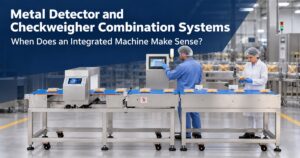
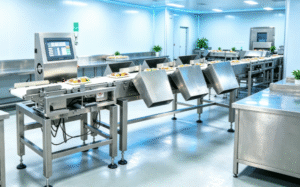
A combination metal detector and checkweigher is a single unit that performs both functions. The product passes through the metal detection coil first, then over the weigh platform. If either inspection fails, the product is rejected.
Key advantages:
-
Smaller footprint
-
Lower cost than two separate machines
-
Single reject point, easier to manage
-
Simplified validation and calibration
Considerations:
-
Speed limitations: the combined unit must handle the line speed without compromising accuracy.
-
Product changeover: ensure recipes can be stored for both functions.
Positioning on the Line
The ideal location depends on your process. Common placements:
-
End of line: After primary packaging, before case packing.
-
Before critical processes: Before a mixer, extruder, or filler to protect equipment.
Always consider the product flow, reject handling, and accessibility for maintenance.
Key Selection Factors
When choosing a metal detector and checkweigher—whether separate or combined—consider the following:
| Factor | What to Evaluate |
|---|---|
| Product type | Dry, wet, frozen, hot, or packaged? |
| Packaging material | Metalized film can affect metal detection; choose the right frequency. |
| Line speed | Must match or exceed production rate. |
| Weight range & tolerance | Determines checkweigher accuracy and capacity. |
| Metal sensitivity | Smallest detectable fragment (e.g., 0.8 mm Fe). |
| Reject system | Air blast, pusher, or flap—depends on product and speed. |
| Environment | Washdown, dust, temperature extremes. |
| Data & connectivity | Ethernet, OPC UA, MES integration for Industry 4.0. |
JINDUN Solutions for Combined Inspection
JINDUN offers both standalone and combination systems for food and pharmaceutical production lines. Our metal detector and checkweigher combination units are designed for:
-
High sensitivity metal detection (down to 0.8 mm Fe, 1.0 mm non-Fe, 1.2 mm SS)
-
Accurate dynamic weighing (up to ±0.5 g depending on product)
-
Speeds up to 200 products per minute
-
Easy integration with existing conveyors and reject systems
-
Stainless steel construction, IP65 washdown rating
-
10-inch color touchscreen with multi-language support
We also provide Food Metal Detectors and Weight Sorting Machines as separate units, allowing you to build the inspection system that fits your exact needs. Our team supports installation, calibration, and training to ensure your line operates at peak efficiency.
Frequently Asked Questions
Q: Can a metal detector also check weight?
A: No. Metal detectors only identify metal contaminants; they do not measure product weight. A checkweigher is required for weight verification.
Q: Can a checkweigher detect metal?
A: No. Checkweighers measure weight only. They cannot distinguish metal from other dense materials.
Q: Do I really need both if my product is already inspected visually?
A: Visual inspection cannot reliably detect small metal fragments or weight deviations. Automated inspection is far more consistent and is often required by food safety standards.
Q: What is the typical cost of a combination system?
A: A combination metal detector and checkweigher costs more than a single unit but less than two separate machines. It also saves space and reduces maintenance. For a quote tailored to your line, contact JINDUN.
Q: How often should I calibrate the combined system?
A: Daily calibration checks are recommended for high-risk products. Weekly calibration is sufficient for general packaging. Always recalibrate after maintenance or product changeover.
Q: Can the system handle metalized film packaging?
A: Yes, but you need a metal detector with the correct frequency and phase discrimination. JINDUN offers models optimized for metalized film.
Conclusion
A metal detector and a checkweigher serve two different but equally critical roles on a production line. The metal detector protects consumers from physical hazards, while the checkweigher ensures weight accuracy and reduces waste. Using only one leaves a gap in your quality control.
For many food manufacturers, the most efficient solution is a combination metal detector and checkweigher—a single system that performs both inspections, saves space, and simplifies compliance. Whether you choose separate units or an integrated model, the goal is the same: complete product safety and quality assurance.
Key takeaways:
-
Metal detectors find metal; checkweighers verify weight. They are not interchangeable.
-
Using both ensures full compliance with food safety and weight regulations.
-
Combination systems save space, cost, and maintenance time.
-
JINDUN provides expert guidance to select and integrate the right solution.
Ready to Upgrade Your Quality Control?
Not sure whether your production line needs a metal detector, a checkweigher, or both? Contact JINDUN for a free consultation. Our engineers will help you choose the right equipment, integrate it seamlessly, and train your team for optimal performance.
JINDUN – Precision Inspection for Safer Food Production.
What is the difference between metal detection and metal separation?
Metal separation removes contaminants from raw materials before processing, while metal detection identifies metals in processed products to ensure safety.
Where should food metal detectors be installed in a production line?
Detectors are typically placed after critical processing steps and before packaging, complementing upstream separation measures.
Can metal detectors prevent all types of contamination?
No, they are highly effective for ferrous, non-ferrous, and stainless steel metals, but should be combined with other control measures for comprehensive safety.
How often should metal detectors be calibrated in a full contamination control system?
Regular calibration is essential. Frequency depends on product type, production volume, and regulatory requirements.
How does integrating detection with other measures improve food safety?
Combining separation, detection, and complementary processes ensures multiple layers of protection, reducing the risk of contamination and equipment damage.
Share With
Related Articles

Hot Products