Table of Contents
What do food retailers and certifiers expect in audits?
Metal detectors in food applications play a critical role in ensuring product safety and regulatory compliance. From raw material inspection to finished product screening, these systems help food manufacturers detect ferrous, non-ferrous, and stainless steel contaminants that may enter the production process.
Metal contamination can enter the food supply at virtually any stage of production—from raw materials arriving with embedded metal fragments, to worn processing equipment shedding particles, to packaging line components breaking down. Left undetected, a single piece of metal can break into smaller fragments and contaminate hundreds of finished food packs, potentially resulting in entire batches being recalled.
This article explores how metal detectors are applied in food production, the different types available, where they should be installed, and best practices for implementation.
How Do Food Metal Detectors Work?
Most food-grade metal detectors operate using a balanced coil system. The search head contains three coilarranged in a precise configuration: a center coil that acts as a transmitter, and two outer coils that serve as receivers.
Manufacturers worldwide rely on metal detectors in food applications to meet HACCP and FDA regulatory requirements.When a product passes through the detector, a high-frequency electromagnetic field is generated. Under normal conditions—when no metal is present—the signals from the two receiver coils balance each other out. During setup, the detector is tuned to the normal electromagnetic signal created by the specific product and its packaging, establishing a “product profile”.
If a metal contaminant passes through the aperture, it disrupts the electromagnetic field. This disruption changes the output signal by mere microvolts. When that signal falls outside the tuned product profile and exceeds the programmed detection threshold, the detector identifies the event and triggers an alarm, activates a reject mechanism, or stops the production line.
Modern metal detectors have evolved significantly from the first industrial unit produced in 1948, moving from valves to transistors to integrated circuits and microprocessors. Today’s systems offer greater sensitivity, stability, and flexibility, with advanced features like multi-frequency operation that can scan through multiple frequencies simultaneously to improve detection capability.
What Types of Metal Can Food Metal Detectors Detect?
The primary advantage of metal detectors in food applications is their ability to detect a wide range of metal contaminants.Food metal detectors are capable of detecting three primary categories of metallic contaminants:
Ferrous Metals
Metal detectors in food applications, Metals containing iron, such as mild steel, carbon steel, and cast iron. These are typically the easiest to detect because they are both magnetic and highly conductive. Ferrous metals amplify the electromagnetic field when they pass through the detector, creating a strong signal.
Non-Ferrous Metals
Metals without iron content, including aluminum, copper, brass, lead, and tin. Although they are non-magnetic, non-ferrous metals are good electrical conductors and can be detected relatively easily.
Stainless Steel
This is generally the most difficult type of metal to detect, particularly 300 series stainless steel (such as 304 and 316 grades), which is both non-magnetic and a relatively poor electrical conductor. To identify stainless steel contamination effectively, detectors often require higher operating frequencies because the high-frequency field induces a current in the stainless steel that creates a detectable signal. In dry products, a stainless steel sphere typically needs to be approximately 50% larger than a ferrous sphere to generate a similar signal.
The ability to detect stainless steel is further hindered when the product is wet or has a high salt content. This is why food manufacturers should not rely only on sensitivity figures from dry test samples—the true measure of performance is how the detector performs on the actual product, in the actual packaging, at the actual production conditions.
Types of Metal Detectors in Food Processing
Understanding how metal detectors in food applications operate is essential for quality control managers.Metal detectors used in food applications generally fall into four main categories, each designed for specific production scenarios:
1. Conveyor / Tunnel Metal Detectors
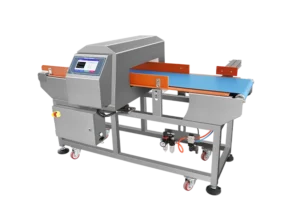
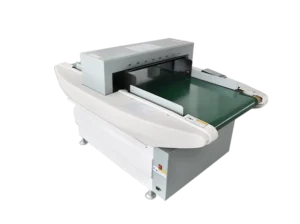
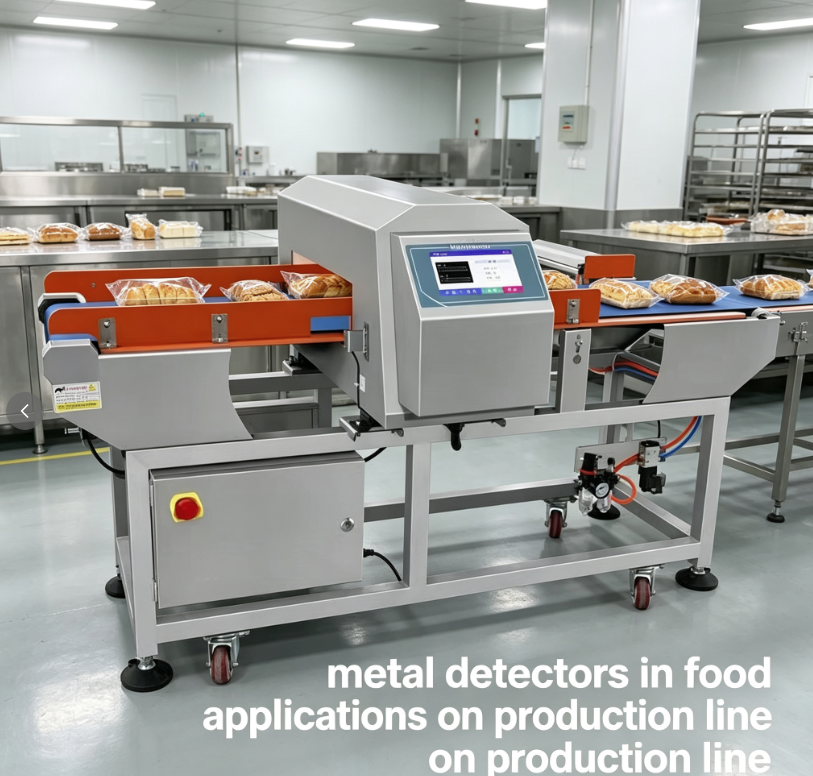
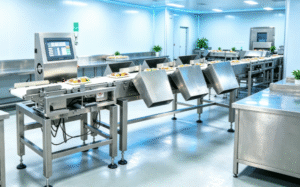
These are the most common type, designed to be integrated seamlessly with conveyor systems at the beginning, middle, or end of the production line. They inspect a wide range of foods and beverages, including both packaged and unpackaged items. Conveyor metal detectors are particularly effective for meats, cheeses, frozen foods, convenience meals, and bakery products. Advanced models can overcome the “product effect”—the natural electrical conductivity of high-moisture foods that can generate signals similar to metal.
2. Gravity Fall Metal Detectors
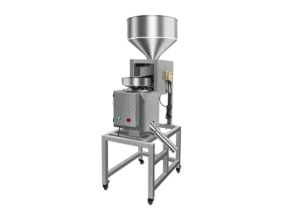
These detectors are specifically designed for the inline inspection of free-falling powders and granular products in non-pressurized applications. Common applications include flour, sugar, spices, grains, and nuts. When contamination is detected, an integrated rejection device diverts the contaminated stream into a separate container.
3. Throat / Vertical Metal Detectors
These detectors can be combined with Vertical Form, Fill & Seal (VFFS) equipment to inspect free-falling food products during processing and packaging. They are ideal for snacks and confectionery applications, particularly those using metallized packaging. These systems can detect unwanted metal pieces in the product flow before packaging while overcoming interference from metallic packaging materials.
4. Pipeline Metal Detectors
Pipeline detectors inspect pumped liquids, pastes, slurries, and vacuum-filled products for metal contamination. Applications are wide and varied, including sauces, dairy products, ground meat, and plant-based sausage. Specific pipeline systems are designed for products prone to bubbles or voids, while others are optimized for integration with vacuum fillers and linking machines.
Where Should Metal Detectors Be Installed in Food Production?
When selecting metal detectors in food applications, consider product type, packaging, and production speed.Metal contamination can occur at various stages of food production, making strategic placement of metal detectors essential. Common contamination sources include:
Raw materials – Ingredients may arrive with embedded metal fragments from harvesting, initial processing, or transportation
Processing equipment – Worn or damaged machinery parts (blades, screens, conveyors) are frequent culprits
Packaging lines – Fast-moving components and sealing equipment can shed small particles
Human error – Tools or personal items accidentally introduced during maintenance or cleaning
In food applications, metal detectors are commonly installed on conveyors, gravity-fed lines, pipeline systems, or at final pack inspection points. The best location for a metal detector depends on the process, the product, and the contamination risk.
Upstream detection—inspecting raw ingredients and bulk materials—is particularly valuable because contaminants can be identified and rejected in their largest and least processed form. This early detection reduces the risk of fragmentation, prevents widespread contamination, and minimizes costs since fewer rejects are required.
End-of-line detection—inspecting finished packaged products—is also common practice. Many food manufacturers install metal detectors as late as possible in the process, often after final packaging, to catch any contamination that may have been introduced during processing or packaging.
HACCP guidance recommends locating Critical Control Points (CCPs) at any step where hazards can be prevented, eliminated, or reduced to acceptable levels. In practice, every food processor’s metal detection needs will vary based on their ingredients, equipment, and process flow.
Metal Detection and HACCP Compliance
Metal detection is a global and industry-wide Critical Control Point (CCP) requirement in food manufacturing facilities. Most food processors would not be able to ship products to retailers without inspecting for metal contaminants at one or more checkpoints on their production line.
Under the FDA’s Food Safety Modernization Act (FSMA), food facilities are required to identify physical hazards, implement controls, validate those controls, and maintain records. Metal detection typically functions as a control measure and may serve as a CCP or preventive control, depending on the hazard analysis.
A HACCP-based food safety plan will typically define metal detection as a control measure at specific critical control points, with documented limits and monitoring procedures attached. Proper documentation, validation, calibration records, and training are required to satisfy auditors.
Industry standards such as BRCGS require that foreign body detection equipment be validated to confirm it can reliably detect contamination at defined critical limits under worst-case production conditions.
Typical sensitivity guidelines for a metal detector with an aperture height of up to 50mm are approximately 1mm for ferrous and non-ferrous metal and 1.5mm for stainless steel. In practice, many processors work with benchmarks of 1.5–2.0mm for ferrous, 2.0–2.5mm for non-ferrous, and 2.5–3.0mm for stainless steel spheres.
Validation, Verification, and Testing Best Practices
The effectiveness of metal detectors hinges entirely on rigorous, systematic testing protocols. Industry best practice follows a structured approach:
Validation – Conducted during initial equipment installation to ensure the detector suits the specific products being inspected. Validation confirms that the equipment meets production objectives based on product characteristics and sensitivity requirements.
Verification – Sensitivity checks with test pieces should be performed at every shift start and after any product change. A formal calibration should be performed weekly or whenever verification fails, and a comprehensive service and certification should be completed annually by a qualified technician.
Routine Performance Monitoring – Conducted during active production to identify sensitivity shifts from equipment adjustments, ingredient variations, or normal wear.
Certified test pieces containing ferrous, non-ferrous, and stainless steel spheres are used for performance validation. Tests should be performed with test pieces positioned at various locations—front, center, and back of packages—to ensure consistent detection regardless of contaminant position.
When calibrating, it is essential to simulate normal production conditions including product flow, conveyor speed, and load to ensure the detector behaves as it will in real operation. For vacuum-packed, wet, or highly conductive products, additional sensitivity reduction or product effect compensation features may be necessary.
Emerging Technologies and Trends
The food metal detection industry is evolving rapidly with several key technological trends:
Multi-Frequency Technology – Modern systems now utilize Multi-Simultaneous Frequency (MSF) technology that can reduce false rejects by up to 50% compared to legacy single-frequency models. Multi-frequency detectors perform well across a wider range of products as they can better ignore the product effect.
Digital Signal Processing – Advanced algorithms and digital filters can suppress environmental interference noise that might otherwise require reducing sensitivity levels manually.
Connectivity and Industry 4.0 – Integration with IoT allows for real-time remote monitoring, data analysis, and predictive maintenance. Modern detectors offer connectivity features such as Ethernet/IP and Modbus.
Combination Systems – Metal detectors are increasingly integrated with other inspection technologies—checkweighing, X-ray, and vision inspection—on unified platforms that reduce footprint and simplify data management.
Conclusion
Metal detectors are essential tools in modern food production, serving as the critical safeguard against metallic contamination that can harm consumers and damage brands. From raw ingredient inspection to final packaging, these systems protect food safety at every stage of production.
Selecting the right type of detector—whether conveyor, gravity fall, throat, or pipeline—depends on the specific product, production environment, and contamination risks. However, equipment alone is not enough. Effective metal detection requires proper validation, regular verification, routine testing, and integration into a comprehensive HACCP-based food safety program.
As regulatory requirements become more stringent and consumer expectations continue to rise, investment in reliable metal detection technology is not merely a compliance obligation—it is a fundamental commitment to food safety and brand protection. When used correctly, a food metal detector gives manufacturers a reliable method of protecting consumers and maintaining the highest standards of product quality. If You Are Interested, Please Feel Free To Contact Me:
Phone / WhatsApp: Cathy +8613662905005
WeChat: Cathy 13662905005
Email: sales05@jindunmachinery.com
FAQ
Q: What is a food metal detector?
A: A food metal detector is an automated inspection system designed to identify and reject ferrous, non-ferrous, and stainless steel contaminants from food processing and packaging lines. It uses electromagnetic fields to detect conductive or magnetic disturbances within products.
Q: What metals can a food metal detector detect?
A: Food metal detectors can detect three main groups of metallic contaminants: ferrous metals (iron, steel), non-ferrous metals (aluminum, copper, brass), and stainless steel. Stainless steel is the most difficult to detect, especially 304 and 316 grades.
Q: Why does my metal detector give false signals?
A: False signals can be caused by electromagnetic interference from variable frequency drives, servo motors, unshielded cables, ground loops, vibration, temperature fluctuations, or the “product effect” from wet, salty, or high-moisture foods.
Q: How do you calibrate a food metal detector?
A: Calibration involves warming up the detector for 15–30 minutes, verifying conveyor speed matches production, confirming grounding and EM shielding, then using certified test pieces (ferrous, non-ferrous, stainless steel) at multiple positions across the aperture. Verification should be performed at every shift start and after product changes.
Q: Where should a metal detector be installed on a production line?
A: Metal detectors can be installed at multiple points: upstream on raw materials (to catch contaminants early), in-process on conveyors or pipelines, or at end-of-line on finished packaged products. The optimal location depends on the product, process, and contamination risks.
Q: Is metal detection a HACCP requirement?
A: Metal detection is a global and industry-wide Critical Control Point (CCP) requirement in food manufacturing. However, the presence of a metal detector does not automatically require it be designated as a CCP—it depends on the hazard analysis. If metal is identified as a food safety hazard reasonably likely to occur, the HACCP plan must include at least one CCP to control it.
Q: How sensitive should a food metal detector be?
A: Typical sensitivity benchmarks are approximately 1.5–2.0mm for ferrous, 2.0–2.5mm for non-ferrous, and 2.5–3.0mm for stainless steel spheres. Actual sensitivity depends on metal type, product characteristics, aperture size, and environmental conditions.
Not sure which metal detection system fits your production line? Contact JINDUN for equipment selection support.
Share With
Related Articles



Hot Products