End-of-line inspection is what most factories rely on — and this story shows why it can fail. A customer recently reported finding a metal-ceramic dental crown inside a branded nut pastry bought from a warehouse store. The factory had a metal detector at the end of its packaging line — so how did such a hard foreign object reach the consumer?The answer is uncomfortable but instructive: the end-of-line detector was working exactly as designed. The problem is that end-of-line inspection alone is not enough.
This is not an isolated case. Contamination enters food at many points — in raw materials, during cutting, mixing, and packaging — and by the time a product reaches the end of the line, the evidence of where it came from is already gone. This article explains why food manufacturers who rely only on end-of-line checks leave their brands exposed, and how a full-line foreign object control strategy protects consumers, cuts waste, and saves money.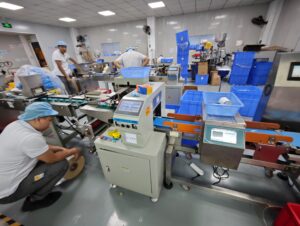
What Is End-of-Line Inspection (and Why Is It Standard)?
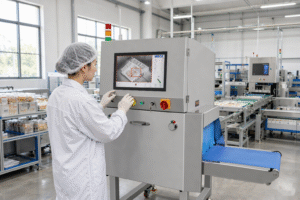
End-of-line inspection is the final quality check on a production line: finished, packaged products pass through a metal detector or X-ray system just before they are shipped. It is the last barrier between the factory and the consumer, and it is required or strongly recommended by most food safety schemes, including IFS, BRC, and HACCP-based programs.
For good reason — if a contaminant survives to this point, the end-of-line system is the final chance to stop it. A properly configured metal detector or X-ray inspection system at the end of the line can reliably reject contaminated product before it ships.
But here is the critical point: end-of-line inspection catches contamination. It does not prevent it. And prevention — finding problems earlier, where they cost less — is where most of the value lies.
Control Points vs Critical Control Points: The Basics
To understand why end-of-line inspection is not enough, it helps to use the language of HACCP, the food safety framework used worldwide.
What Is a Control Point (CP)?
A Control Point (CP) is a specific step in the process chain where a check can be carried out, but where there is no elevated risk of a safety hazard. Controls at these points are managed through general hygiene and quality measures, and the manufacturer decides which checks to perform.
Example: a muesli manufacturer inspects incoming nuts with an X-ray system for bulk goods at goods receipt, catching stones and metal before they enter the process. This is a CP — useful, but not strictly mandatory under HACCP.
What Is a Critical Control Point (CCP)?
A Critical Control Point (CCP) is a step where a hazard must be prevented, eliminated, or reduced to an acceptable level. CCPs are non-negotiable: they are the points where action must be taken, critical limits set, and monitoring records kept.
Example: the same muesli manufacturer operates an end-of-line check on finished packages with a metal detector or X-ray system. Because physical contamination can no longer be removed after this point, it is designated a CCP — the “last line of defense.”
CP vs CCP at a Glance
|
Control Point (CP) |
Critical Control Point (CCP) |
|
|
Risk level |
No elevated hazard risk |
Must prevent/eliminate a hazard |
|
Mandatory? |
Manufacturer’s discretion |
Required by HACCP |
|
Typical location |
Raw materials, process steps |
End of line, critical process steps |
|
Monitoring |
General quality checks |
Critical limits + records |
|
Example |
Nuts X-ray at goods receipt |
End-of-line metal detection |
The important insight: a CCP at the end of the line protects the consumer — but it protects neither your equipment, your batch, nor your traceability. Those require controls further upstream.
5 Reasons End-of-Line Inspection Alone Is Not Enough
Reason 1: Contaminants Get Ground Into Undetectable Fragments
Foreign bodies that enter the process early — a metal bolt in grain, a stone in flour, a piece of glass in a raw mix — get crushed, milled, and blended as the product moves through the line. A contaminant that was large enough to be caught at intake can become dozens of tiny fragments, many below the detection limit of any inspection system.
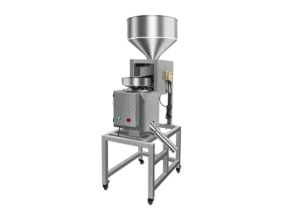
By the time the product reaches the end of the line, the evidence may be physically impossible to find. The only way to catch these contaminants is to find them before they are broken down — at goods receipt or at the process step where they enter. A bulk X-ray system or metal separator at intake catches a stone or bolt while it is still a single, detectable object — before milling turns it into fragments too small for any detector. JINDUN bulk inspection systems handle throughputs from 0.5 to 10 tonnes per hour, sized to your intake rate, so contamination is removed at the moment it arrives.
Reason 2: Contamination Damages Your Equipment
Foreign bodies do not just threaten consumers — they threaten your machinery. A metal bolt in grain can destroy mill rolls. A screw in plastic pellets can damage an extruder screw or scoring a mold cavity. A stone in a filling line can block nozzles and cause downtime.
This is a double loss: you pay for the repair, and you lose production while the line is stopped. Worse, damaged equipment can shed new fragments into the product, creating a second contamination source. Detection upstream — for example, a metal separator at the feed point — protects the equipment that protects your product. A separator installed above the feed of an extruder or molding machine removes tramp metal before it reaches the screw, saving thousands in repairs and hours of downtime. JINDUN separators detect ferrous, copper, and stainless steel contamination automatically, with no operator attention required.
Reason 3: You Lose the Ability to Trace the Source
When contamination is only found at the end of the line, you know a problem exists — but you do not know where it came from. Was it the supplier’s batch? The cutting blades? A worn part in the filler? The packaging machine?
Full-line inspection changes this. If raw materials are checked at intake, ingredients at each process step, and products at the end of the line, a contamination event immediately points to a source: a batch, a machine, a time window. This is not just about quality — it is the foundation of root-cause analysis, supplier management, and audit defence.
Reason 4: You Waste Entire Batches, Not Just One Product
Here is the economics of end-of-line-only inspection: when contamination is found at the end of the line, the entire batch is suspect. In practice, this means the finished, packaged, labelled product — often a full batch — is quarantined or disposed of.
With early detection, only the contaminated piece or ingredient is rejected. The difference is the difference between losing one product and losing a day’s production — packaging, labour, and energy included. Consider a line running 120 pieces per minute: in an 8-hour shift that is nearly 58,000 packaged products. A contamination event that quarantines the shift discards all of them — versus a single rejected piece when the contaminant was caught earlier. At typical retail prices, that is the difference between a few cents of loss and tens of thousands of dollars.
Reason 5: You Throw Away Value You Already Paid For
Every product that reaches the end of the line has already accumulated cost: raw materials, processing time, energy, packaging, and labour. When it is rejected at the final inspection, all of that value is destroyed.
Early detection preserves that value. A contaminant found at intake is removed before a single processing step. A contaminant found mid-process costs only the partial work already invested. The earlier the detection, the less value is destroyed — and the higher your effective yield and profit margin. A simple example: a stone in a batch of nuts found at intake costs nothing to remove. The same stone found after sorting, roasting, seasoning, and packing has cost you every step of that processing — plus the packaging. Early detection is, quite literally, money saved.
Where Contamination Actually Enters Your Line
Foreign objects can enter at any point, which is why “one checkpoint” thinking fails. The most common entry points are:
Raw Material Intake
Stones, metal, and other contaminants travel with raw ingredients — especially grains, nuts, seeds, and recycled or bulk materials. Checking materials at goods receipt with an X-ray system or metal separator prevents contamination from ever entering the process.
Processing and Cutting
Knives, blades, screens, and sieves wear out. Fragments from worn or broken cutting and milling equipment are a leading source of metal contamination in meat, bakery, and snack production.
Mixing and Filling
Pumps, mixers, and fillers shed particles through wear. High-speed filling also risks foreign bodies falling into open product streams.
Packaging
Staples, clips, and fragments from packaging machinery can end up inside sealed packs. This is one of the few risks that genuinely only appears at the packaging stage.
Line Risk Map and Recommended Equipment
|
Process stage |
Typical contamination |
Recommended inspection |
|
Raw material intake |
Stones, metal, glass in bulk materials |
X-ray (bulk) or metal separator |
|
Milling / crushing |
Metal from screens, hammers |
Metal separator / gravity metal detector |
|
Cutting / slicing |
Blade fragments |
Conveyor metal detector |
|
Mixing / filling |
Wear particles, loose parts |
Conveyor metal detector |
|
Packaged product |
Metal, glass, bone, dense plastic in packs |
X-ray inspection system |
|
Final weight compliance |
Under/overweight packs |
Checkweigher |
How to Build a Full-Line Inspection Strategy
Step 1: Map Your Contamination Risks
Walk your line from goods receipt to goods dispatch. List every point where a foreign body could enter, and every step where the product changes form (milling, mixing, cutting). This risk map is the backbone of your strategy — and of your HACCP plan.
Step 2: Choose the Right Technology for Each Point
No single technology covers everything:
- Metal detectors — fast, affordable, ideal for metal-only risk at line speed
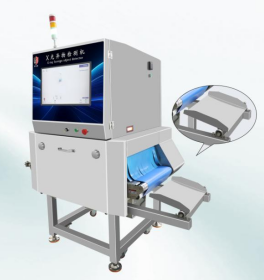
- X-ray inspection — detects metal plus glass, stone, bone, and dense plastic, and works through foil packaging
- Metal separators — protect mills, extruders, and molding machines from tramp metal in bulk materials
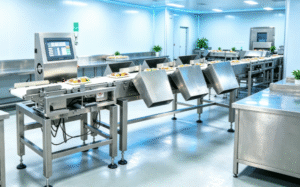
- Checkweighers — verify weight compliance and catch missing pieces
Match the technology to the risk at each point, rather than installing the same machine everywhere. For example, a metal detector with Fe Φ0.8 mm sensitivity suits dry snacks and packaged foods where the risk is metal. An X-ray system — detecting metal at Φ0.4 mm plus glass, stone, and bone — suits products with mixed contamination risk or foil packaging. Bulk materials call for a gravity metal separator; weight compliance calls for a checkweigher. Choosing the right tool for each risk point is what turns a collection of machines into a strategy.
Step 3: Set Critical Limits and Monitor
For each CCP, define critical limits — for example, the smallest metal fragment your system must detect — and validate the system against them with test pieces. Monitor performance daily, and keep records that survive an audit.
Step 4: Use Data for Root-Cause Analysis
Modern inspection systems record images of good and rejected products, with quantities and timestamps, exportable for analysis. This data turns a “we had a reject” event into “rejects spiked at 14:30 on Station 3, batch 47” — which is exactly what an auditor or a supplier conversation needs.
Step 5: Combine Technologies for Layered Protection
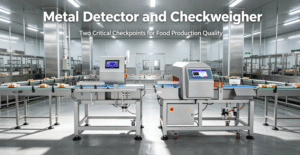
Many manufacturers combine a metal detector early in the line (to protect equipment and remove large hazards) with an X-ray system at the end (as the comprehensive final check) and a checkweigher for weight compliance. Where floor space is tight, a combined metal detection + checkweighing system does both jobs in a single footprint — the same layered protection in one machine.
JINDUN Equipment for Every Point on Your Line
A full-line strategy is only as good as the machines at each point. Here is how JINDUN equipment covers every inspection stage, with real specifications:
|
Inspection point |
JINDUN equipment |
Key specifications |
|
Bulk materials at intake |
Gravity metal separator |
0.5–10 t/h throughput; catches ferrous, copper, stainless steel |
|
Conveyor products (dry & wet) |
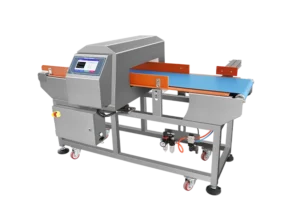
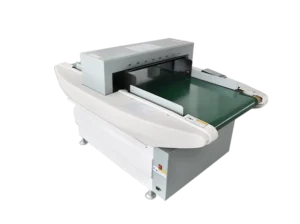
Conveyor metal detector JD-605 |
400×150 mm aperture; Fe 1.2 / Cu 2.0 / SUS 2.5 mm; 110 product recipes; 7-inch touchscreen; 304 stainless steel |
|
Foil & metalized packaging |
Aluminium foil detector JD-606 |
400×100 mm; ferrous detection; Dutch food-grade belt (−20 to +65 °C); 100 recipes |
|
Packaged products (end-of-line) |
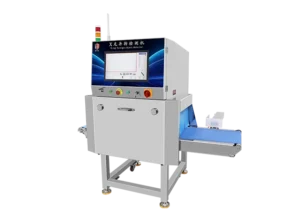
X-ray inspection JD-4016 / 4022 / 5025 / 6030 |
0.3–0.4 mm stainless steel ball; tunnels 400×160 to 600×300 mm; Siemens PLC, Hamamatsu detector; 17-inch screen |
|
Weight compliance |
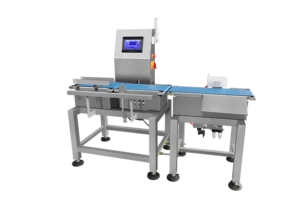
Checkweigher JD-520 |
±0.3–10 g over 2–2000 g; Mettler Toledo load cell; 100 product recipes |
|
Small batches / static checks |
Small sorting scale JD-501 |
±0.1 g up to 500 g; 35 packs/min; 7-inch OLED screen |
Every JINDUN machine is built in food-grade 304 stainless steel, carries a 12-month warranty with remote online commissioning, and is backed by a manufacturer with years of experience in food inspection equipment. These are the machines behind the full-line strategy described in this guide — matched to the risk at every point, from goods receipt to the end of the line.
Real Examples: What Early Detection Saves You
Case 1: Frozen Dumplings — Blade Fragments
A frozen dumpling line faces a classic risk: knife and equipment fragments mixing into the filling. Detected only at the end of the line, a contaminated batch means quarantining an entire shift of finished product. With a conveyor metal detector at the filling step, the contaminated piece is rejected in seconds — the rest of the batch keeps running.
Case 2: Nut Pastries — The Metal-Ceramic Fragment
The nut pastry incident that opened this article is the perfect illustration: a hard, composite foreign object that a standard end-of-line detector struggled to identify. An X-ray system — which detects by density rather than conductivity — catches such composite objects that a metal detector cannot reliably see. Layering the two technologies closes the gap.
Case 3: Nuts and Dried Fruit — Stones and Glass
Bulk nuts and dried fruit routinely carry stones, glass, and metal fragments from harvest and processing. Checking bulk material at intake with an X-ray system removes these before they reach slicing, grinding, or packing — where a single stone could damage equipment and contaminate a whole batch.
Common Mistakes in Foreign Object Control
- Treating end-of-line inspection as “enough” — it protects the consumer but not your equipment, batches, or traceability
- Installing one technology everywhere — metal detectors and X-ray systems solve different problems
- Ignoring goods receipt — contamination that never enters the process costs nothing
- Skipping validation — a detector that is not tested against real contaminants gives false confidence
- Not using the data — rejection records are an audit asset, not just paperwork
Conclusion
End-of-line inspection is essential — but it is the last line of defense, not the whole strategy. Contaminants enter at goods receipt, during milling, cutting, mixing, and packaging. Finding them early protects your equipment from damage, preserves the value of your batch, gives you traceability for root-cause analysis, and turns a potential whole-batch loss into a single-piece rejection.
The manufacturers who build inspection into every stage of the line — not just the end — produce safer food, waste less, and defend their audits with data. That is what full-line foreign object control means.
Want to build a full-line inspection strategy for your production line? Contact JINDUN — our engineers will help you map your contamination risks and select the right technology for each point on your line.
FAQS