Introduction
X-ray fish bone detection solves a problem that has troubled the seafood industry for decades. Fish is a healthy, popular food — but the tiny bones hidden inside it are a constant worry for both consumers and processors. A single sharp bone that reaches a customer can mean a complaint, a return, or worse, a health risk. And here is the frustrating part: most fish bones are practically invisible. They are hard to see by eye, and a metal detector cannot find them at all. This is exactly where X-ray inspection comes in. This article explains how X-ray technology detects fish bones, and where it fits in your seafood processing line.
Why Fish Bones Are the Hardest Contaminant in Seafood
Fish bones are unusually difficult to detect for three reasons.
Low Density and Low Mineral Content
Unlike metal or dense stone, fish bones are light and have low mineral content. In an image, a thin fish bone can look almost identical to the surrounding fish muscle, making it easy to miss.
Thin, Needle-Like Shape
Fish bones are long, thin, and sharp — the hardest kind of object for many inspection systems to catch. Their small cross-section produces only a faint signal.
The Health Risk They Carry
A swallowed fish bone can lodge in the throat and cause serious injury. Supermarkets and food-service buyers know this, which is why many now demand “bone-free” fish products. Processors are under pressure to deliver a guarantee that is genuinely hard to keep.
A metal detector offers no help here — fish bone is not metal, so it passes straight through without triggering any alarm. Visual inspection is equally unreliable, since bones hide inside the flesh.
How X-Ray Imaging Detects Fish Bones
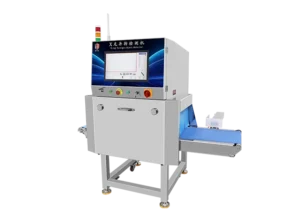
X-ray inspection works on density, not magnetism. As a fish fillet passes through the inspection tunnel, an X-ray beam penetrates it and produces a grayscale image. Any material denser than the surrounding flesh — including bone — appears as a darker or lighter region on the image.
The key is that fish bone, even though it is light, is still denser than pure muscle. With the right system configuration and imaging algorithms, this small density difference is enough to make the bone visible on screen.


What Affects X-Ray Fish Bone Detection
Whether a given fish bone is detected depends on several factors, which is why detection is always confirmed by testing the actual product.
Single-Energy vs Dual-Energy Imaging
Standard systems use single-energy imaging, which is effective for most fish products. For more demanding applications — where bone and flesh density overlap heavily — dual-energy imaging is available as a custom option. Dual-energy uses two energy levels to separate materials by composition rather than density alone, improving bone detection in difficult products.
Product Density and Thickness
Thicker, denser products absorb more X-rays, which can reduce the visibility of fine bones. Thin fillets are easier to inspect than thick blocks or layered products.
Line Speed and Resolution
Higher line speeds reduce inspection time per product. The right balance between speed and resolution depends on your product and your detection target.
Where JINDUN X-Ray Is Used in Seafood Processing
X-ray fish bone detection fits into several seafood applications:
- Frozen fish fillets — detecting residual pin bones before packing
- Surimi, fish balls, and fish cakes — catching bone fragments in processed fish products
- Ready-to-cook and breaded fish — inspecting coated products where bones are hidden
- Smoked and marinated fish — verifying boneless claims on premium products
In practice, JINDUN systems have been shown to detect fish bones in real fish products — the images above are from an actual detection test. Because every product is different, the exact smallest detectable bone size is confirmed by sending a sample for testing.
Tips to Improve Fish Bone Detection
Test Your Actual Product First
The only reliable way to know what your system can detect is to run your real product through it. Send a sample and confirm the result before committing.
Choose the Right Tunnel Size
Match the inspection tunnel to your largest product. JINDUN tunnel sizes are named by width × height — for example, the JD-4016 has a 400 × 160 mm tunnel, with larger models for wider lines.
Use Remote Commissioning Support
X-ray systems need correct calibration for each product. JINDUN systems support remote online commissioning and diagnostics, so engineers can help tune the system for your specific fish product without an on-site visit.
Conclusion
Yes — X-ray fish bone detection finds tiny fish bones in fish products, including the pin bones that are invisible to metal detectors and the human eye. The key is matching the system, the imaging technology, and the settings to your specific product. For seafood processors looking to deliver a genuine “bone-free” guarantee, X-ray inspection is the most reliable tool available.
Worried about fish bones in your products? Contact JINDUN and send us a sample — we will test it and show you exactly what our X-ray system can detect.