Introduction
X-Ray Foreign Body Detection Machines go far beyond traditional metal detectors. Metal detectors have long been the standard for foreign body inspection in food manufacturing, but here’s the reality: not all contaminants are metal. Glass fragments from broken jars, calcified bones in meat and poultry, stones from agricultural harvests, and dense plastics from packaging materials can all find their way into finished products—and a metal detector won’t catch any of them.
This is where X-ray foreign body detection machines come into play. Unlike metal detectors that rely on electromagnetic fields to identify only metallic contaminants, X-ray inspection systems generate detailed images of products as they pass through the inspection tunnel, detecting a wide range of foreign materials based on density differences .
The result is a comprehensive inspection solution that protects consumers from harm, shields your brand from recalls, and helps you meet the most stringent global safety standards.
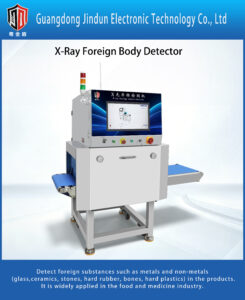
What Is an X-Ray Foreign Body Detection Machine?
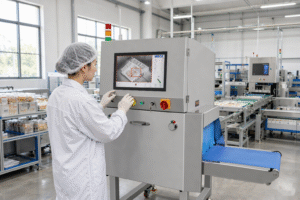
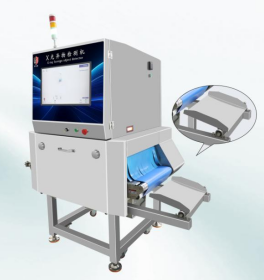
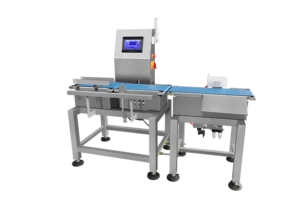
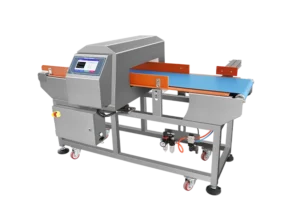
An X-ray foreign body detector is an automated inspection system that uses X-ray technology to scan products and identify contaminants that would otherwise go undetected . The system typically consists of:
-
X-ray generator: Emits X-rays that pass through the product
-
High-resolution detector: Captures the X-ray image as it exits the product
-
Image processing software: Analyzes the image for anomalies
-
Rejection mechanism: Automatically removes non-conforming products
-
HMI touchscreen: Allows operators to configure settings and monitor performance
As products move along the conveyor, the X-ray beam penetrates them. Denser materials—like metal, glass, or bone—absorb more X-rays and appear darker in the image, while the product itself appears in varying shades of grey based on its composition and density . Advanced algorithms then detect these anomalies and trigger an automatic rejection.
What Can an X-Ray Foreign Body Detector Find?
X-ray systems can detect a much broader range of contaminants than metal detectors alone :
| Contaminant Type | Detectability |
|---|---|
| Ferrous metals (iron, steel) | Very high |
| Stainless steel | Very high |
| Aluminum | Detectable |
| Glass | Detectable |
| Stone | Mostly detectable |
| Calcified bone | Some detectable |
| High-density plastics (PVC, Teflon) | Detectable |
| Rubber | Detectable |
| Organic contaminants | Limited |
Critical insight: X-ray systems detect contaminants based on density differences—substances with higher density than the product itself are easier to identify .
Key Applications of X-Ray Foreign Body Detection in Food Production
Meat & Poultry Processing
Metal detectors struggle with wet, salty meat products that create “product effect.” X-ray systems are far less affected by product composition and can detect bone fragments, metal, and glass even in challenging applications like ground meat, sausages, and fillets . For high-speed deboning lines, dual-energy X-ray systems with AI-powered software can identify bone-in-trim before further processing.
Seafood & Fish Processing
One of the most valuable applications is detecting tiny fish bones in fillets and ground seafood products. Dual-energy technology can differentiate between bone and product even when densities are similar—something conventional single-energy X-ray systems often miss .
Packaged Foods
For packaged goods in metalized foil or aluminum packaging where light and traditional metal detectors cannot penetrate, X-ray systems provide complete visibility . They can inspect canned goods, ready meals, snack bags, and sealed trays, detecting both contaminants and verifying fill levels and product completeness.
Bulk Products
For unpackaged, loose-flow products on conveyors—dried fruits, nuts, cereals, pulses, potatoes, and frozen vegetables—modern bulk X-ray systems can detect contaminants as small as 0.3–0.4 mm while processing up to 5,000 kg per hour .
Bakery & Snack Lines
X-ray inspection detects dense or hidden particles in sealed trays and bags, including metal, glass, and hard plastics that may break off from processing equipment .
Dairy & Cheese Processing
Processed cheese and dairy products are increasingly inspected with X-ray systems to ensure product completeness and contaminant-free packaging .
X-Ray vs. Metal Detector: Which One Does Your Line Need?
This is one of the most common questions in food safety. Here’s the simple answer:
| Factor | X-Ray System | Metal Detector |
|---|---|---|
| Contaminants detected | Metal, glass, stone, bone, dense plastics | Metal only |
| Product effect | Less affected by wet/salty products | Affected by moisture, salt, frozen products |
| Additional capabilities | Fill level, shape, count, seal inspection | Detection only |
| Packaging compatibility | Works with aluminum, foil, metal packaging | Limited with metal packaging |
| Cost | Higher investment | Lower investment |
| Line speed | Generally adequate for most lines | Can handle very high speeds |
Best practice: X-ray and metal detection are complementary technologies . Many manufacturers use both—metal detectors at strategic points where metal contamination is most likely, and X-ray systems where the risk of non-metal contaminants or packaging challenges exists.
X-Ray Inspection Safety: Is It Safe for Food Products?
Radiation safety is a common concern. Here are the facts:
-
No harmful radiation remains in products: X-ray inspection is a transmission technology—products pass through the beam and absorb some energy, but they do not become radioactive
-
External emission is minimal: Leading systems comply with <1 µSv/h external emission standards (U.S. and EU requirements)
-
Safety features are built-in: X-ray shielding curtains, door safety switches, key switches, and emergency stop buttons protect operators
-
No special operator qualifications required: Modern systems are designed for safe operation without radiation-specific certifications. JINDUN X-Ray Foreign Body Inspection Equipment
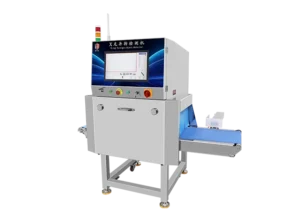
JINDUN X-Ray Inspection Equipment is engineered for high-sensitivity detection across a wide range of food and industrial applications. Built with the latest detector technology and designed for demanding production environments, JINDUN systems deliver reliable contaminant detection and complete quality assurance.
Key Features of JINDUN X-Ray Inspection Systems
| Feature | Benefit |
|---|---|
| High-sensitivity detector | Detects metal, glass, bone, stone, and dense plastics |
| Dual-energy option | Advanced material discrimination for challenging low-density contaminants |
| 304 stainless steel construction | Food-grade, corrosion-resistant, hygienic design |
| AI-powered detection algorithms | Reduces false rejects and adapts to product variations in real time |
| Multi-product memory | Quick changeover with stored parameters |
| Integrated rejection system | Air blast, push rod, swing arm, or drop-down options |
| High-speed throughput | Handles high-volume production without slowing the line |
| OPC UA / Ethernet IP connectivity | Seamless integration with smart factory systems |
| Hygienic IP ratings | Washdown-ready designs for food environments |
Applications Supported
-
Packaged meat and poultry
-
Seafood and fish processing
-
Bakery and confectionery
-
Dairy and cheese
-
Ready meals and convenience foods
-
Snacks and cereals
-
Pharmaceutical inspection
-
Plastic and electronic manufacturing
Compliance
JINDUN X-ray systems are designed to meet international safety standards, helping manufacturers comply with HACCP, BRC, IFS, FDA, and retailer requirements.
FAQ: Common Questions About X-Ray Foreign Body Detection
Can X-ray systems replace metal detectors?
No. X-ray and metal detection serve different roles. Metal detectors remain essential for certain applications—particularly for detecting lightweight foil strips, very thin blades, and low-density alloys. Many manufacturers use both as complementary technologies .
What types of defects can X-ray detect?
Beyond foreign bodies, X-ray systems can inspect fill levels (underfilled or overfilled containers), product shape and count, seal integrity, missing components, and relative mass. They can even detect jamming in multi-lane packaging lines .
Is X-ray inspection safe for food products?
Yes. X-ray inspection does not make products radioactive. Modern systems comply with strict radiation safety standards (<1 µSv/h external emission), and built-in safety features protect operators .
Does X-ray work with aluminum packaging?
Yes! Unlike metal detectors, X-ray systems can inspect products in aluminum foil, metalized film, and even canned goods where light does not penetrate .
Is X-ray suitable for high-speed production lines?
Yes. Modern X-ray systems can handle high-speed production, with bulk flow systems processing up to 5,000 kg/hour and packaged product systems scanning at line speeds matching packaging equipment .
What is the difference between X-ray and a metal detector for foreign body detection?
X-ray detects based on density differences and can identify a much broader range of contaminants (metal, glass, bone, stone, dense plastics). Metal detectors rely on conductivity and magnetism, detecting only metallic contaminants. X-ray is also less affected by product effect (wet, salty products) and works with metal packaging .
Conclusion
X-ray foreign body detection is no longer a luxury—it’s a necessity for manufacturers serious about comprehensive food safety. By detecting contaminants that metal detectors miss and providing additional quality checks (fill levels, shape, count), X-ray systems deliver unmatched protection for your brand and your customers.
JINDUN X-Ray Inspection Equipment combines advanced detection technology, hygienic stainless steel construction, and smart connectivity features—making it a reliable partner for food manufacturers committed to the highest safety standards.