Why “Purchase Price” Is Only a Small Part of the Real Cost
When evaluating a Food Metal Detector, many buyers focus almost entirely on the initial purchase price. Quotations are compared, budgets are approved, and decisions are often made based on who offers the lowest number.
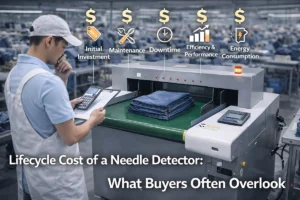
But in industrial environments, the purchase price is only the entry point. Over the next five to ten years, the detector will generate costs—or savings—through installation, calibration, operation, maintenance, stability, and downtime. A lower upfront price can easily turn into a higher total expense if the system lacks reliability, adaptability, or long-term support.
For production managers and engineers, the real question should not be “How much does it cost to buy?” but “How much will it cost to own?”
The Hidden Cost Stages Across a Food Metal Detector’s Lifecycle
Installation and Line Integration Costs
Every production line is different. Conveyor heights, product flow direction, surrounding equipment, and space constraints all affect how a detector is installed.
A system that appears inexpensive may require:
- Custom mechanical modifications
- Conveyor reconstruction
- Control system reconfiguration
- Additional shielding or environmental protection
These integration costs are rarely visible in a quotation but can significantly affect the total investment.
Commissioning and Calibration Time
After installation, a detector must be tuned for real products. Moisture content, packaging materials, temperature, and product density all influence sensitivity.
Long commissioning cycles mean:
- Delayed production
- Additional engineering hours
- Repeated test runs and product waste
A well-designed system reaches stable performance faster, reducing hidden startup costs.
Daily Operation and Energy Consumption
In continuous food production, equipment often runs 24/7. Small differences in energy efficiency and control stability compound over thousands of operating hours.
Poorly optimised systems may:
- Require higher power input
- Drift in sensitivity over time
- Need frequent manual intervention
These operational inefficiencies quietly increase long-term expenses.
Maintenance, Wear Parts, and Service Intervals
Every detector contains components that age: belts, bearings, seals, electronics, and sensors.
Long-term cost is shaped by:
- Frequency of calibration
- Availability of spare parts
- Ease of on-site maintenance
- Service response time
A lower-priced machine with frequent service needs can cost far more over its lifetime than a robust industrial design.
The Cost Impact of False Rejects and Missed Contaminants
Performance stability directly affects operational cost.
- False rejects lead to unnecessary product loss, rework, and labour.
- Missed contaminants create safety risks, recalls, and brand damage.
In high-volume food production, even a 0.5% false reject rate can translate into tons of wasted material each year. Meanwhile, a single contamination incident can carry regulatory and reputational costs far exceeding the price of the machine itself.
True lifecycle value lies in consistent detection performance—not just headline sensitivity numbers.
Downtime: The Most Expensive Cost You Never See in a Quotation
Downtime is rarely itemised in a purchase proposal, yet it is often the most expensive consequence of poor equipment choice.
A single hour of line stoppage can mean:
- Lost production output
- Idle labor
- Missed delivery windows
- Upstream and downstream disruptions
In environments with heat, humidity, vibration, or washdown requirements, weak mechanical structures and unstable electronics increase failure risk. Reliability under real industrial conditions is a cost factor that never appears on paper—but is always paid in practice.
How to Evaluate a Food Metal Detector from a Lifecycle Perspective
Instead of comparing quotations alone, buyers should evaluate:
- Whether the mechanical design supports continuous 24/7 operation
- How easily can sensitivity be adjusted for new products
- Whether software allows future process upgrades
- The supplier’s long-term service capability
Industrial-grade Food Metal Detector systems are engineered not only for detection accuracy, but for durability, adaptability, and operational stability. This is where experienced manufacturers such as Jindun Elec differentiate—by designing for years of real-world production, not just initial acceptance tests.
Making a Smarter Investment Decision
Buying a metal detector is not a one-time transaction. It is a long-term operational commitment.
When viewed through a lifecycle lens, the best investment is not the cheapest machine, but the system that:
- Runs reliably under real conditions
- Minimises waste and rework
- Protects both equipment and brand
- Adapts as products and regulations evolve
This shift—from price-based buying to system-based thinking—is what separates short-term savings from long-term efficiency.
Conclusion
The true cost of a food metal detector is not defined by its purchase price, but by everything that happens over the next decade of production. Installation complexity, calibration time, operational stability, maintenance demands, false rejects, and downtime all shape the real financial impact.
By evaluating detectors from a lifecycle perspective, manufacturers can reduce risk, improve efficiency, and build more resilient production lines. If you are planning to invest in detection equipment that performs reliably over the long term, Contact Jindun Elec to explore solutions engineered for real industrial conditions.
FAQ