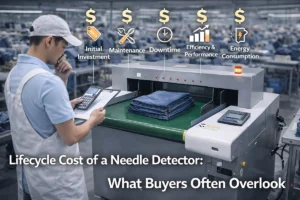
In many garment and textile factories, purchasing a needle detector is treated as a one-time equipment decision. Buyers often compare models by price, sensitivity level, or brand reputation, assuming the lowest upfront cost represents the best value.
However, experienced manufacturers know that the real expense is not the purchase price—it is what the system costs over five to ten years of daily operation. Downtime, false rejects, maintenance, recalibration, and audit risks quietly accumulate. In practice, a “cheaper” system can become far more expensive over its lifetime.
Understanding lifecycle cost shifts the decision from “Which machine is cheaper?” to “Which solution truly costs less to own?”
What Is “Lifecycle Cost” in Needle Detection?
Before evaluating systems, it is essential to understand what lifecycle cost actually includes.
Initial Purchase vs. Long-Term Ownership
The purchase price is only the entry point. Real cost is generated during years of operation—when the system interacts with materials, operators, and production pressure. Every adjustment, stoppage, and rejected batch adds to the total.
Typical Cost Phases Over 5–10 Years
A Needle Detector typically generates costs in five main phases:
- Purchase and installation
- Daily operation
- Maintenance and calibration
- Downtime and production losses
- Compliance and audit risk
These costs rarely appear in a quotation, yet they define the true financial impact.
With this framework in mind, the hidden expenses become much clearer.
Hidden Costs That Buyers Often Miss
Many factories only realise these costs after the system is already installed.
False Rejects and Production Loss
Excessive false alarms force operators to recheck products, repeat scanning, or halt packing lines. Over time, this leads to:
- Increased labour hours
- Slower throughput
- Missed delivery windows
In high-volume garment lines, even small inefficiencies compound into substantial losses.
Downtime Caused by Unstable Detection
Unstable systems require frequent manual adjustments. When sensitivity drifts or environmental interference occurs, production stops. Each interruption may last minutes—but across months, the accumulated downtime becomes significant.
Maintenance and Spare Parts
Sensor wear, electronic drift, and ageing components increase service needs. Systems with complex or proprietary parts often carry higher replacement costs and longer repair cycles.
Re-Calibration and Re-Training
Every new fabric type, padding layer, or garment structure may require recalibration. New operators also need training. When adjustment depends heavily on experience, inconsistency becomes a cost of its own.
These factors are not inevitable—but they are common in poorly matched systems.
How the Right Needle Detector Reduces Total Cost
Not all needle detection systems behave the same over time. Proper design dramatically lowers lifecycle expense.
Stability Over Extreme Sensitivity
Ultra-high sensitivity looks attractive on paper, but instability creates constant interruption. In real garment environments, stable detection with predictable behaviour saves far more time and labour.
Design for Garment Production Reality
Effective systems account for:
- Multi-layer fabrics
- Metallic buttons and accessories
- Filling materials and seams
- Continuous manual handling
When design matches reality, fewer adjustments are required.
Smart Compensation and Auto-Balance
Modern control logic automatically adapts to fabric variation and environmental change. This minimises manual intervention and keeps production flowing without sacrificing safety.
A purchasing decision made once often determines these costs for years.
What Smart Buyers Evaluate Before Purchase
Experienced buyers assess beyond specification sheets.
Total Cost of Ownership (TCO) Thinking
Rather than focusing on unit price, they evaluate:
- Annual downtime risk
- Maintenance workload
- Training dependency
- Audit stability
The most economical system is the one that performs consistently with minimal disruption.
Service Capability and Local Support
Installation, calibration guidance, and response speed directly affect long-term cost. Local support shortens recovery time and stabilises operations.
Compliance and Audit Readiness
Major brands expect traceable detection processes. Equipment that simplifies documentation, testing routines, and audit preparation reduces management burden and compliance risk.
This system-level thinking reflects how Jindun Elec approaches industrial inspection solutions—not as isolated machines, but as long-term production assets.
Turning Needle Detection into a Long-Term Asset
A well-chosen Needle Detector is not merely a safety device—it becomes part of operational infrastructure. Stable detection means:
- Fewer interruptions
- Lower rework rates
- Predictable output
- Stronger customer confidence
Over time, these advantages outweigh initial purchase differences. The right system transforms from a cost centre into a productivity safeguard.
For manufacturers seeking stable, audit-ready, and production-aligned needle detection systems, Contact Jindun Elec to explore solutions built for real factory conditions.
FAQs